TSPDT placing: #49
Directed by: Alfred Hitchcock
Written by: Ernest Lehman
Starring: Cary Grant, Eva Marie Saint, James Mason, Jessie Royce Landis, Leo G. Carroll, Martin Landau, Philip Ober
WARNING: Plot and/or ending details may follow!!!
Following the commercial failure of Vertigo (1958), Alfred Hitchcock needed a crowd-pleaser. He certainly gave us one. North by Northwest (1959) might just be the most outright entertaining of the director's pictures, a film that exists solely to give its audience a rollicking good time. Throughout his career, Hitchcock often utilised his established stars – for example, Cary Grant in Suspicion (1941) or James Stewart in Vertigo – as an opportunity to deconstruct their ingrained public image. Here, instead, he simply goes with the flow. In his fourth and final film for the Master of Suspense, Cary Grant plays with a familiar persona – debonair and charming, cocky and mischievous. His Roger O. Thornhill (the arbitrary middle initial an overt jab at producer David O. Selznick) is an advertising executive, superficial and self-serving, but with the charisma to support these dastardly qualities. Such a man is surely in need of a comeuppance, and Hitchcock delights in every plot twist that sees Thornhill plunged ever further into a sadistic practical joke cooked up by the Cold War.
 Ernest Lehman's screenplay outwardly appears to be little but a selection of spectacular set-pieces strung together by Hitchcock's trademark "wrong man" motif, but it nonetheless amply supports its running-time (among the director's longest). Cary Grant's charming banter with double-agent Eva Marie Saint is tinged with sly sexual innuendo, and only Hitchcock could have ended a film with the hero's train entering the leading ladies'…. well, you get the picture. James Mason brings a dignified vulnerability to the role of Commie spy Phillip Vandamm, but Hitchcock seems only marginally interested in the character, and, indeed, his ultimate fate is completely skipped over (instead, Martin Landau's vicious henchman is given an arch-villain's death). Hitchcock's climax atop a studio reconstruction of Mount Rushmore is only effective thanks to Bernard Hermann's momentous score, but other sequences reek of the director's astonishing aptitude for suspense. The breathless crop-duster ambush is worthy of every accolade that has been bestowed upon it, and Grant's comedic talents shine during both a drunken roadside escape and an impromptu auction-house heckle.
 That the audience learns of George Kaplan's fictitiousness long before Thornhill ever does may admittedly weaken the suspense, but Hitchcock's motives are instead to recruit the audience into his own position, as director, of omnipotent power. Beneath its surface, North by Northwest appears to be a subtle swing at Cold War politics, and particularly the power wielded by the FBI and government committees like the HUAC. As Thornhill fights to unravel himself from a tangled web of deception and espionage, Hitchcock unexpectedly crosses to a panel of FBI agents, headed by Leo G. Carroll, who bicker indifferently over the mess into which they've got this oblivious pawn. These government employees are happy to sit listlessly by as citizens place their lives on the line, their quarrels bizarrely resembling the conversations of the gods in Jason and the Argonauts (1963). Indeed, like deities, the FBI men wield the power to invent (Kaplan), destroy, or even resurrect (Thornhill) human beings, and intercede sporadically in a suitably Deus Ex Machina-like fashion.
9/10
Currently my #3 film of 1959:
1) Die Brücke {The Bridge} (Bernhard Wicki)
2) Room at the Top (Jack Clayton)
3) North by Northwest (Alfred Hitchcock)
4) Some Like It Hot (Billy Wilder)
5) Our Man in Havana (Carol Reed)
6) On the Beach (Stanley Kramer)
7) Le Quatre cents coups {The 400 Blows} (François Truffaut)
8) Pickpocket (Robert Bresson)
9) Ben-Hur (William Wyler)
10) The Tingler (William Castle)
2) Room at the Top (Jack Clayton)
3) North by Northwest (Alfred Hitchcock)
4) Some Like It Hot (Billy Wilder)
5) Our Man in Havana (Carol Reed)
6) On the Beach (Stanley Kramer)
7) Le Quatre cents coups {The 400 Blows} (François Truffaut)
8) Pickpocket (Robert Bresson)
9) Ben-Hur (William Wyler)
10) The Tingler (William Castle)

 Whereas A Streetcar Named Desire had been a completely stage-bound film, owing to origins on Broadway, East of Eden (1955) allowed Kazan to spread his cinematic wings, so to speak. Steinbeck had intended his novel, in part, as a tribute to the Salinas Valley in Northern California, and so location is everything. Cinematographer Ted McCord captures the setting in lush WarnerColor, the fertile green fields consciously opposed to the bleak inner conflict raging inside the heart of the film's protagonist. Despite being visually impressive, it is – as in all Kazan pictures – the director's genius for working with actors that really shines through. James Dean, in his major picture debut (and the first of only three lead roles), delivers one of the most heartbreakingly tragic performances I've ever seen. His Cal, the Biblical Cain to Richard Davalos' Abel, has endured a life without love, every misguided bid for his father's (Raymond Massey) approval met with indifference or remonstration, as though only to cement his self-belief that he is inherently "bad."
 In adapting "East of Eden," another director might have aimed for sheer scope, winding up with something not unlike
  In Wagon Master, Ford seems so comfortable with his tried-and-tested Western formula that any character development is largely glossed over. Ben Johnson's romance with Joanne Dru is treated as an obligation more than anything else, and Harry Cary Jr's charming of a Mormon girl is so perfunctory as to be almost nonexistent in the final film, leaving one to ponder the survival of deleted scenes. Only in Charles Kemper's charismatic and shamelessly-villainous Uncle Shiloh does Ford try some different, and it works, even with his being surrounded by a troop of insufferably hammy slack-jawed yokels. Where Ford does succeed is in orchestrating the conglomeration of three distinct races of Americans – the values-orientated Mormoms, the easygoing horse-traders, the eccentric travelling showmen – into a cohesive community of pioneers looking towards a bright future. This apparent harmony is thrown into disarray by the arrival of Uncle Shiloh's gun-toting outlaws, who exploit the lawlessness of the Western frontier but ultimately lose out to the noble cowboys who "only ever drew on snakes."
  Ford reportedly considered Wagon Master among the favourite of his films, and perhaps this has something to do with the absence of big names like John Wayne or Henry Fonda. Armed only with his stock selection of usual players, Ford is able to generate a sense of community by avoiding placing focus on any one character, though most of the Mormom travellers still remain completely anonymous. Despite being undoubtedly well-made, I can't help feeling that this film only does well what other Ford pictures did even better: the terrific majesty of the the Western frontier was presented more beautifully in She Wore a Yellow Ribbon; the romances and friendly squabbles among community members took greater prominence in Fort Apache; the early relations with Native Americans, only hinted at here, were more thoroughly examined in
  Blanche DuBois is an intriguing character because she is a tragic victim despite bringing much of her fate upon herself. Having shamed herself in scandal following the loss of her family home, Blanche arrives in New Orleans in complete denial of her moral failings. While desperately maintaining a facade of upper-class respectability, Blanche continually speaks of her brother-in-law Stanley with utter condescension, deriding his Polish heritage and working-class habits. Only by disparaging others can she sustain her self-enforced illusion of lingering youth and grandeur, and yet every attempt at remaining young ironically makes her seem as old as Norma Desmond. But Stanley is also a brute, exuding primitive cruelty and sexuality through every sweaty pore. Had he understood Blanche's psychological condition, and offered kindness instead of resistance, her breakdown might have been averted. Stanley's pig-headed selfishness is despicable, and yet – like Blanche – his behaviour seems to arise not from deliberate cruelty, but from child-like naiveté, an obliviousness towards the consequences of his actions.
 There's no doubt that A Streetcar Named Desire finds its performers at the peak of their work, but, even so, I consider it a minor miracle that such contrasting acting styles were able to coexist so comfortably. Though Marlon Brando had previously performed the role on Broadway to great acclaim, the studio-appointed casting of Vivien Leigh provoked some consternation among the crew, who feared a clash of "classical" and "method" acting styles. Leigh, speaking with a Southern accent that is, I think, inherently theatrical, accentuates every twitch of insecurity in the emotionally-decaying Blanche DuBois. Brando, on the other hand, was a student of Lee Strasberg at the Actors' Studio, an influential proponent of method acting, and his Stanley Kowalski speaks in an often- incomprehensible drawl that works precisely because you can imagine hundreds of uneducated New Orleans workers speaking in the same manner. The gamble on Leigh proved successful, with she and co-stars Karl Malden and Kim Hunter taking home Oscars for their fine work; Brando lost out to Bogart in
  Wajda's film opens with an cold-blooded ambush, in which two concrete factory workers are needlessly gunned down in a case of mistaken identity. These shootings take place at the front steps of a country chapel, and with a child within earshot, highlighting the heartless resolve with which the Home Army rebels carry out their murders. However, despite the pro-Communist climate in which Wajda produced his film, he stops well short of demonising the "enemy" rebels, and, indeed, young Maciek is portrayed as the tragic victim of the story. In fact, the film goes to some length to emphasise the parallels between Maciek and Communist leader Szczuka (Waclaw Zastrzezynski), implying the needlessness of their conflict, and so the tragedy of their fatal opposition: both men fought valiantly against fascist dictatorships (the former in both Spain and Poland), and remember fondly the war comrades who died in pursuit of an ideal that, to both, should now be deemed realised. Instead, Szczuka dies in Maciek's arms as Poland celebrates its liberation.
 Polish cinema reached its peak in the late 1950s, following the Khrushchev Thaw that saw an ease in Soviet censorship, and Andrzej Wajda was at the forefront of this cinematic New Wave. Jerzy Wójcik's stark black-and-white cinematography is elaborate and beautifully-executed, capturing the main character's claustrophobic isolation using closed sets and a cramped frame. The war itself took many prisoners, but Maciek – ironically a "freedom fighter" – finds his freedom restrained in a less overt manner. Even with the liberation of Poland, Maciek is obligated to continue his blood feud, denied the ordinary happiness offered by a life with pretty bar-maid Krystyna (Ewa Krzyzewska), with whom he spends a night. Cybulski's character squanders most of the film in boisterous, overcrowded surroundings, finding room to move only in fractured moments, such as a late-night stroll through the crumbling town ruins. Even in his death throes, Maciek stumbles through a cluttered wasteland of garbage, ultimately joining the detritus of the twentieth century's most costly conflict.
 Henri Danglard (Jean Gabin) is a respected theatre producer who lives the high life, despite relying upon financial backers to sustain his extravagant lifestyle. A charming chap, and convincingly debonair given his age, Danglard shares the company of the beautiful but temperamental Lola de Castro (María Félix), into whose bed many have attempted to climb (and probably with little resistance). When Danglard woos a pretty young laundry-worker, Nini (Françoise Arnoul), into dancing the cancan for him, Lola is overrun with jealousy, and all sorts of anarchy takes place amidst this romantic rivalry. Meanwhile, a handsome European prince (Giani Esposito) offers Nini his hand in marriage, but she's not willing to make such a dishonest commitment, more inclined to stay with Danglard, who inevitably plots to discard her as soon as his next promising starlet comes along. Jean Gabin, who had previously worked with Renoir in the 1930s, is terrific in the main role, overcoming his mature age to succeed as a potential lover.
 It's interesting to compare Hollywood films of the 1950s with their European counterparts. Thanks to the Production Code, most American romantic comedies kept the romance almost entirely platonic, whereas here Renoir's characters speak of sex and adultery as though it is a perfectly acceptable practice. Even the adorable Françoise Arnoul, who occasionally reminded me of Shirley MacLaine, is treated as an openly sexual women, and not just because her character specialises in a dance designed purely to display as much leg as possible. Like many of Renoir's films, the characters themselves aren't clearly defined, and so it's difficult to form an emotional attachment. Indeed, only in the final act does Danglard come clean with the extent to which he romantically exploits his dance recruits, though even this moment is overshadowed by the premiere show of the Moulin Rouge. Perhaps it is through his caricatures that Renoir is making a quip about bourgeois French society – that they're all hiding behind fallacious identities and intentions. Or am I looking too far into this quaint musical comedy?
 The Bad and the Beautiful employs a similar storytelling device to All About Eve (1950), telling its story almost entirely via noirish flashbacks. Three successful artists – a director, actress and writer – arrive at the home of Jonathan Shields, the disgraced Hollywood producer to whom each of the three owes their monumental success. So why do they loathe him? Shields gave director Fred Amiel (Barry Sullivan) his big break in cinema, worked with him to great acclaim, and then shut him out of his dream project, a Gone with the Wind-like epic called "The Faraway Mountain." Georgia Larisson (Lana Turner) was likewise plucked from obscurity, rescued from a lifetime of self-loathing sex and alcoholism, before being abandoned in her moment of triumph. Novelist James Lee Bartlow (Dick Powell, in another great dramatic role) already had some acclaim, but also the hindrance of distracting Southern belle wife Rosemary (Gloria Grahame). Though he couldn't possibly have foreseen the consequences of his actions, Shields took care of that, as well.
 Each of the three owes their livelihood to Jonathan Shields, and I think that this is the true root of their hatred: they're eternally in debt to him, and like Faust, feel as though they have traded their souls for a room at the top. Kirk Douglas portrays Shields wonderfully, and in the film's most searing moment, he explodes into a fit of rage, his short, stocky stature seeming to inflate as his antagonism grows. But Shields isn't really as inherently "bad" as the film's title would have you believe. He is presented as a flawed genius, whose personal shortcomings stem from the same artistic vein as that which fuels his cinematic intuition (a Graham Greene quote clarifies my meaning: he once described himself as having "a character profoundly antagonistic to ordinary domestic life," and that "unfortunately, the disease is also one's material"). Indeed, Shields was modelled on several filmmakers, most noticeably Val Lewton (whose Cat People (1942) gets an indirect reference), Orson Welles, and David O. Selznick, whose box-office flop
  Tony Hunter (Astaire) is a has-been, a washed-up musical comedy star who's all but faded from the public memory. Anonymity is a fate he's since accepted. When offered the starring role in a stage show written by his friends (and two remaining fans), Tony is at first reluctant, and even more so when he finds out that he'll have to stand his own alongside a beautiful and popular ballet dancer, Gabrielle Gerard (Charisse). It doesn't help that the director (Buchanan) seems oblivious to the show's intended genre, cramming in so much doom and gloom that the premiere audience leaves the theatre in a hushed despair, no doubt contemplating suicide. Can "The Band Wagon" be spruced up with comedy before it leaves them all bankrupt? Will Tony and Gabrielle overcome their differences and learn to like, or even love, each other? A happy ending is, of course, never in doubt, and the musical numbers are all completely enjoyable, even if songs like "Louisiana Hayride" and "Triplets" felt somewhat poorly integrated into the plot.
 Certainly the most memorable of the film's musical numbers is "That's Entertainment," written by by Arthur Schwartz and Howard Dietz, an infectious little ode to the joyfulness of the musical comedy genre. MGM musical fans would note that the song also featured prominently in the nostalgic documentary That's Entertainment: Part II (1976), in which Gene Kelly and Fred Astaire dance together, for only the second time in their careers. Cyd Charisse, whom we lost just last year, is absolutely gorgeous as ballet dancer Gabrielle Gerard, and her wordless pas de deux with Astaire in the park ("Dancing in the Dark") is one of the latter's all-time most most touching duets (equal, perhaps, with the "Never Gonna Dance" number in Swing Time (1936)). Also worth mentioning is a film noir-inspired stage musical sequence, its surrealism recalling the climax of An American in Paris (1951), with Astaire as a weary detective who is entranced by a shifty femme fatale – Cyd Charisse resurrecting her vampiric dancer from Singin' in the Rain (1952).
 The Wages of Fear contains two particular sequences that rival anything Hitchcock ever did in terms of suspense. In the first, to which I briefly alluded above, a small amount of nitroglycerine is utilised to demolish a huge boulder blocking the road, the slightest lapse in concentration certain to lead to disaster. In the second, Mario (Yves Montand) and Jo (Charles Vanel) wallow pathetically in a deepening pool of crude oil, drowning in the black tar that represents the United States' rampant capitalistic greed {the motif of oil epitomising greed is not an uncommon one in cinema, and most recently turned up in P.T. Anderson's There Will Be Blood (2006)}. What I think prevents Clouzot's film from being truly brilliant is the opening half-hour or so, which is not only unsuspenseful, but damn near uninteresting. Of course, I suppose, it's important to note the changes that take place in the characters both before and after their new job – the dominating Joe quickly reveals his cowardice, and the sycophantic Mario takes over the role of boss – but Hitchcock, at least, would have made these introductions far more compelling.
  Towards the film's ending, I have conflicting emotions. On the one hand, it is a wonderful masterwork of cinematography and editing, as Mario's driving is intercut with the waltz of his acquaintances back in town, to the tune of Strauss' "The Blue Danube." There's an astonishing momentum to the camera movements; we foresee what is about to happen at least a minute before Montand's character does, but are powerless to stop it. He carries on his Dance Macabre (a figurative "waltz with death") until he loses control of the truck, begetting a spectacular, fiery plummet over the cliff edge. On the other hand, the entire incident – however satisfying filmically – doesn't seem like a natural progression of the narrative, possessing the air of a conclusion affixed only to achieve a surefire audience reaction. Unfortunately, similar cases of characters acting illogically litter the story, providing what might be described as mere cheap thrills: Mario continues to reverse the truck even after being told to stop, and Luigi, at one point, ludicrously decides to run towards an impending explosion rather than away from it.
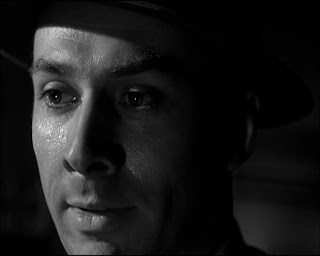 When just-out-of-prison pickpocket Skip McCoy (Richard Widmark) snags the purse of a woman on the subway (Jean Peters), he pockets more than he'd originally bargained for. The woman, Candy, and her cowardly ex-boyfriend Joey (Richard Kiley) had been smuggling top-secret information to the Communists, and McKoy has unexpectedly retrieved an important roll of micro-film. Will he turn in the MacGuffin to the proper authorities, or sell it to the highest bidder? If Pickup on South Street has a flaw, it's that the story seems designed solely to bolster an anti-Communist agenda, reeking of propaganda like nothing since WWII {Dwight Taylor, who supplied the story, also notably wrote The Thin Man Goes Home (1944), the only propagandistic movie of the series}. For no apparent reason, every identifiable character – even the smugly self-serving Skip McCoy – eventually becomes a self-sacrificing patriot, the transformation predictable from the outset. In traditional film noir, the unapologetic criminal always gets his comeuppance, the rational punishment for his sins, but apparently not when they've served their country; patriotism wipes the slate clean.
 Richard Widmark, an actor who I'm really beginning to like, plays the haughty pickpocket with composure, though always with that hint of ill-ease that suggests he's biting off more than he can chew. The opening scene on the train is the film's finest, as McCoy breathlessly fishes around in his victim's hand bag, recalling Bresson's Pickpocket (1959). Thelma Ritter is terrific as a tired street-woman who'll peddle information to anybody willing to pay for it (though, of course, she draws the line at Commies). Jean Peters is well-cast as the trashy dame passing information to the other side, playing the role almost completely devoid of glamour; Fuller reportedly cast the actress on the observation that she had the slightly bow-legged strut of a prostitute. Nevertheless, Peters must suffer a contrived love affair with Widmark that really brings down the film's attempts at realism. Fascinatingly, upon its release, Pickup on South Street was promptly condemned as Communist propaganda by the FBI, and the Communist Party condemned it for being the exact opposite. Go figure.
 Watching Ben-Hur (1959) is a lot like paying a visit to the Colosseum. Situated in Rome, Italy, this massive elliptical amphitheatre is the largest ever built in the Roman Empire, able to seat up to 80,000 spectators for gladiatorial games and various public spectacles. I've never been to Rome myself, but I'd imagine that one would look up at this amazing feat of ancient architecture, and be left in awe at the scale of it all. You would marvel at the amount of care and labour that must have gone into such a project, particularly given the comparatively primitive tools with which the builders had worked. I feel the same way about Ben-Hur – William Wyler's epic of epics, and, at the time, the most expensive film ever made. Winner of eleven Academy Awards, including Best Picture, this colossal cinematic gamble resurrected M-G-M from financial ruin. But is it worth nearly four hours of your time? Like a lumbering elephant, Ben-Hur wallows in its immensity, extravagance and self-importance. But it is epic – oh, so very epic! – and, like the Colosseum, demands our awe.
 Charlton Heston won an Oscar for his portrayal of Judah Ben-Hur, though his performance is merely adequate without being particularly brilliant. Heston, an actor who flourished mostly on sheer charisma, I think, appears to struggle in the film's most emotional moments {my personal pick for the award that year would have been Laurence Harvey in Jack Clayton's Room at the Top (1959)}. Stephen Boyd, though un-nominated, is quite terrific as Messala, Judah's boyhood friend who was later corrupted by the evils of the Roman Empire. Though there are many exciting scenes – such as the fiery ocean battle or Christ's crucifixion – the film's undisputed centrepiece is, of course, the extraordinary chariot race, a marvel of adrenalin-charged action and suspense. Every single metre of the contest had me enthralled, every jolt and tremble of the carriage sending an agitated chill down my spine. The sequence's enduring influence is to be found in practically every historical epic that followed, most noticeably Ridley Scott's Best Picture-winning Gladiator (2000).
 John Huston's rousing adventure was largely filmed on location in Africa, though many of the white-water sequences were obviously shot before a rear-projection screen in London; fortunately, these optical effects are far less distracting on a cinema screen. It can often be problematic to build almost an entire film around just two characters, but Bogart and Hepburn are clearly up to the challenge, sharing a chemistry that is infectiously entertaining. Whether they're engaged in awkwardly-formal conversation, at each other's throats, or falling in love, every line of dialogue (from a screenplay by John Huston and James Agee) is an absolute delight, all the more so because we know that Charlie and Rose will eventually end up in each other's arms. At either end of the adventure, Robert Morley lends some pathos to the tale as Rose's humble missionary brother, who dies following a German raid; and Peter Bull, though perhaps too cartoonish to entirely fit the film's overall tone, adds some lighthearted humour as a temperamental enemy captain.
 Just what is it about The African Queen that has made it such an enormous viewer favourite? I think that much of this has to do with Huston's predominantly lighthearted approach to the material – if you're not gripping your seat in excitement, then you're laughing at the interactions between the two leads. However, there's also a less-pronounced political commentary at play. Reverend Sayer's death might been viewed as symbolising the inevitable death of British Colonialism. That Bogart's roguish, hard-drinking North American (he's actually a Canadian) effectively conquers the prudishness of Hepburn's formal British spinster may likewise be taken to foreshadow the United States' rise as the world's most influential superpower. All politics aside, I find it amusing that just last week I attended a cinema screening of Francis Ford Coppola's
 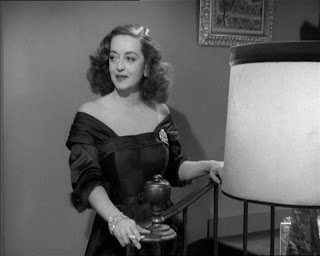 On the brightly-lit stages of Broadway, respected but aging theatre star Margo Channing (Bette Davis) clings extravagantly to roles for which she is far too old; as though Mankiewicz and Billy Wilder were exchanging ideas, you can almost see her turning into Norma Desmond a few years down the track. One night, Margot is introduced to ostensibly her biggest fan, a meek and sincere young woman named Eve Harrington (Anne Baxter) – now, remember that name! Had I known beforehand that Eve is considered one of American cinema's finest villains, the first half of the film would have severely confused me – what detestable qualities could possibly be exhibited by this shy, modest and frankly adorable admirer of theatre? I decided that the mutual looks of contempt with which Margo and Karen (Celeste Holm) greet Eve's theatre award (a less-prestigious version of the Oscars) were merely the result of unfounded jealousy, and their resentment that such a modest girl could have received the high honour. When the penny finally dropped, oh, how I felt like a fool!
 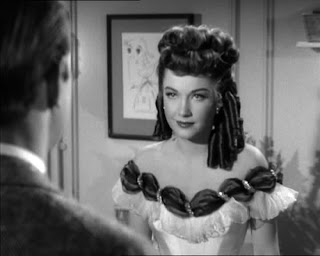 Bette Davis, late in her career, was one of the few actresses with enough sheer charisma to persevere in Hollywood despite her relative lack of glamour or traditional beauty. In All About Eve, her aging features look tired and almost grotesque – I say this not derisively, but as an observation for how well Davis suits her character. Margo Channing could never have been played by an actress still completely at ease with her looks. In comparison, Anne Baxter illuminates every room, particularly after her selfish intentions are revealed to the audience. The moment of revelation, when she stands, still in costume, positively pulsating with ambition, desire and lust, is a shocking betrayal that really took me aback. The film uniquely emphasises female dominance, with the inconsequential, malleable husbands (Hugh Marlowe and Gary Merrill) frequently relegated to the sidelines. However, George Sanders, as the sharp-tongued columnist Addison DeWitt, holds such contemptuous views towards society that he recognises Eve's game from the very beginning, watches it with amused, admiring eyes, before promptly reasserting his male superiority over her in the final scenes.
 What others have said:
 Voyage in Italy is one of those pictures where nothing much happens, at least on the surface. However, this film is a narrow stream that runs deep. Behind every seemingly-inconsequential scene, every awkward glance, every moment of banal interaction, there lies the key to Katherine and Alex's marriage, and the reasons why it's falling apart. Katherine does a lot of lonely driving in Naples, observing the everyday comings-and-goings of the local folk from the vantage point of a passive, almost-nonexistent outsider. She counts the number of pregnant women in the street, and wonders dolefully whether or not her own refusal to bear children has torn apart her marriage. Alex, meanwhile, skirts the borders of infidelity, elevating his boredom by charming beautiful young ladies (none as beautiful as Bergman, it must be said) but thankfully pulling back at the crucial moment. If one were so inclined, the film also works just as well as a travelogue of sorts, exploring, with exquisite detail, the museums of Naples and Pompeii, and the Italian fascination with the dead.
 By 1954, Ingrid Bergman had spent several years working in Italy, after her marital scandal with Rossellini temporarily lost her favour with American audiences. Here, as lovely as ever, she gives a subtle and touching performance, an unappreciated wife disillusioned by the lack of love in her marriage. George Sanders, the roguishly charismatic male suitor in countless 1940s dramas, here achieves a mature, refined level of charm, such that we're not surprised at his ability to woo even the younger ladies. Through their separate travels in Italy, both characters attain a catharsis of sorts, the focus to finally make a clear decision about the future of their relationship together. This leads to a simple but wonderful exchange of dialogue outside the Pompeii excavation site ("Life is so short"; "that's why one should make the most of it"), which seems as good a reason as any for the pair to abandon their seemingly-doomed marriage and start afresh. However, Hollywood sensibility here prevails over Rossellini's neorealism roots, and the realisation that life is fleeting instead encourages Katherine and Alex to reaffirm their love for each other.
 What others have said:
 Considering the director's association with low-budget schlock, I had expected a film with unquestionably shoddy production values. Instead, 'The Tingler (1959)' is impeccably shot by Wilfred M. Cline and generally well-written (Dr. Chapin referencing both his wife and a stray cat: "Have you two met? In the same alley, perhaps?"). Horror icon Vincent Price is the film's charismatic star, but excellent supporting performances are given by Judith Evelyn as a deaf and dumb cinema owner, Philip Coolidge as her anxious husband, and Patricia Cutts – sexy and acerbic – as Dr. Chapin's unfaithful wife. The story does occasionally descend into silliness, but Price nonetheless manages to deliver even the campiest of lines with unmatched class. The Tingler itself looks glaringly artificial, a rubber contraption that is pulled along the floor with wires, but its initial entrance is still something to behold. I leaned forward, my mouth agape in revulsion and disbelief, as the slimy, pulsating creature – seen only in silhouette – was extracted from its host's body, and deposited, wriggling gruesomely, into a pet cage.
 Unlike countless awful 1950s sci-fi/horror films, The Tingler isn't merely in the business of (ostensibly) scaring its audience; it aims to entertain them – to elicit screams, laughs and everything in between. Castle takes you aside with a mischievous wink, lets you in on the joke, and invites you to enjoy the film's effect on the lesser masses. Whether or not his film actually caused any cinema hysterics or fatal heart attacks is difficult to deduce {one of Castle's other tricks was to plant shills in the audience, who would scream on cue}, but there's no doubt that his picture genuinely involved the audience. Every single unsubtle technique utilised by the film – most memorably, the black-and-white suddenly punctuated by blood red, a little trick he learnt from Hitchcock's Spellbound (1945) – is a nod to the participation of its viewers. This makes the film abstract, surreal, almost interactive; when Vincent Price implores the cinema audience to scream, we know he's talking to us, and when the Tingler's stark silhouette creeps slimily across our movie screen… well, don't forget to scream.
 What others have said:


_poster.jpg)


