TSPDT placing: #2
Directed by: Alfred Hitchcock
Written by: Pierre Boileau (novel), Thomas Narcejac (novel), Alec Coppel (screenplay), Samuel A. Taylor (screenplay)
Starring: James Stewart, Kim Novak, Barbara Bel Geddes, Tom Helmore
 WARNING: Plot and/or ending details may follow!!!
John "Scottie" Ferguson has a fear of falling. As the detective dangles precariously from the unstable guttering of a tall building, he impulsively looks downwards to glimpse the distant ground seemingly rushing towards him, all the while paradoxically shifting further and further downwards to maximise his inevitable plummet. This optical effect, sometimes known as a "contra-zoom," "trombone zoom" or even the "Vertigo effect," was invented by Irmin Roberts, a Paramount second-unit cameraman, and Alfred's Hitchcock's use of the technique is pivotal to the success of Vertigo (1958), the director's final collaboration with James Stewart. Human eyes interpret the relative dimensions of objects using a combination of size and perspective signals, and the simultaneous forward zoom / reverse track, which alters perspective while maintaining object size, instantly perplexes our eyesight, triggering sensory confusion and successfully mimicking the dizzying sensation of acrophobia. It may not be an incredibly subtle means of communicating Scottie's vertigo, but it's effective, and, particularly in the film's second half, Hitchcock employs a seamless combination of subtle and blatant film-making techniques to polish his landmark thriller.
Just a few nights ago, I was fortunate enough to attend a double-bill cinema screening of Alfred Hitchcock's classic thrillers Rear Window (1954) and Vertigo (1958), both starring James Stewart and both among the finest pictures in the director's distinguished repertoire. Both films deal quite substantially with the notion of voyeurism, a topic further explored in Hitchcock's crowning masterpiece, Psycho (1960). Rear Window was the greater crowd-pleaser among the two, replete with gleefully-dark dialogue and a delicious murder mystery glimpsed through the rear window of Stewart's cluttered apartment. Vertigo succeeds on distinctly-different terms: though rather lumbering and morose in comparison, the film is easily the Hitchcock's most intense thriller, with little of the playfully-black humour to be found in most of the director's acknowledged classics. This being my second viewing, it was interesting to note a film divided into two rather-incompatible halves, one a leisurely, borderline-supernatural ghost story, and the other a vivid exploration of loss and obsession. It's a curious combination – and one that I fear contradicts some commentators' claims of "perfection" – but it's also an altogether fascinating one.


The film's opening half concerns acrophobic detective Scottie Ferguson (James Stewart), who has retired from the police force after his disability caused the death of a colleague. An old colleague, Gavin Elster (Tom Helmore), hires Scottie is surveil his wife Madelaine (Kim Novak), whom he tentatively suspects of having been inhabited by the spirit of a tragic-afflicted ancestress. Hitchcock confidently strings together a series of surveillance episodes, as Scottie tails Madelaine across San Francisco, observing her fixation with her nineteenth-century counterpart, culminating in an attempted suicide at the base of the Golden Gate Bridge. These sequences move at an unhurried pace, usually with extended periods of silence, underscored by Bernard Hermann's eerie soundtrack. However, to one with prior knowledge of the story's eventual conclusion, these comprehensive episodes of observation seem rather superfluous, a deception that exists as a trifling footnote to the film's primary concerns, of obsession and doomed passion. In any case, Scottie soon finds himself falling in love with Madelaine, and, when she is tragically wrenched from his grasp, his own grip on reality begins to falter.
The film's second half, following Madelaine's apparent suicide, marks a crucial turning-point in both the story and our perception of the major characters. James Stewart, long considered the "everyday man" with his shy and polite demeanour, suddenly descends into darkened territory, emerging from his cocoon of self-pitying isolation only after attaining a streak of relief from the face of a passing stranger, Judy Barton (Kim Novak again). In a wretched bid to recapture the passion of his lost love, Scottie forcefully alters Judy's appearance to reconstruct Madelaine's image, and, in one of Hitchcock's all-time most powerful moments, the pair embrace in a hotel room, the camera spinning deliriously about them as their surroundings modify to momentarily evoke the memory of Scottie and Madelaine's final, blissful kiss. However, in choosing to construct a superficial duplicate of his love, Scottie has effectively thwarted any romantic future, and, when it is revealed that Judy and Madelaine were the very same person – the fabrication of an elaborate murder plot – he comes to realise that, not only had he initially "fallen" for an illusion, but his own self-made illusion was equally unviable, if not more so.
9/10
Currently my #1 film of 1958:
1) Vertigo (Alfred Hitchcock)
2) Touch of Evil (Orson Welles)
3) The Fountain of Youth (Orson Welles) (TV)

Currently my #4 film from director Alfred Hitchcock:
1)
Psycho (1960)
2)
Strangers On A Train (1951)
3)
Rear Window (1954)
4)
Vertigo (1958)
5)
Rope (1948)
6)
Rebecca (1940)
7)
North by Northwest (1959)
8)
I Confess (1953)
9)
The Lady Vanishes (1938)
10)
Spellbound (1945)
11)
Dial M for Murder (1954)
12)
Frenzy (1972)
13)
Foreign Correspondent (1940)
14)
The Birds (1963)
15)
Stage Fright (1950)
16)
Shadow of a Doubt (1943)
17)
Lifeboat (1944)
18)
Notorious (1946)
19)
The 39 Steps (1935)
20)
Sabotage (1936)
21)
The Man Who Knew Too Much (1934)
22)
Torn Curtain (1966)
23)
The Man Who Knew Too Much (1956)
24)
The Trouble with Harry (1955)
25)
Blackmail (1929)
26)
Under Capricorn (1949)
27)
Secret Agent (1936)
28)
The Lodger (1927)
29)
Number Seventeen (1932)
30)
Family Plot (1976)
31)
Suspicion (1941)
32)
Murder! (1930)
33)
Rich and Strange (1931)
34)
Easy Virtue (1928)
 What others have said:
"Vertigo (1958), which is one of the two or three best films Hitchcock ever made, is the most confessional, dealing directly with the themes that controlled his art. It is about how Hitchcock used, feared and tried to control women. He is represented by Scottie, a man with physical and mental weaknesses (back problems, fear of heights), who falls obsessively in love with the image of a woman--and not any woman, but the quintessential Hitchcock woman. When he cannot have her, he finds another woman and tries to mold her, dress her, train her, change her makeup and her hair, until she looks like the woman he desires. He cares nothing about the clay he is shaping; he will gladly sacrifice her on the altar of his dreams."
Roger Ebert, October 13, 1996
"Hitchcock makes crafty use of Stewart's all-American image by casting him as the anxious, struggling anti-hero. It's a setup for the classic story in which the hero rescues a distressed woman. But the director takes pains to make us see just how culpable Scottie is, to the extent of having him castigated at length for his negligence by the coroner (Henry Jones) at the inquest after Madeleine's death. I've never before been quite so struck at the accuracy of the coroner's devastating monologue. It's small wonder that Scottie soon finds himself under professional care."
Walter V. Addiego, San Francisco Examiner, 1996
"Vertigo is an enjoyably duplicitous film, full of artificiality in both the film-making (lots of back projection) and the story (things not being what we thought), in other words: pure Hitchcock. Added to this is composer Bernard Herrmann's particularly haunting score, with its falling and rising melody representing Scotty's giddy state of mind as his obsession with Madeleine escalates, and also the heights of the San Francisco locations he roams... Hitchcock's Vertigo is a psycho-drama where he replaces the suspenseful set-piece with bitter emotion and twisted motive; and the absence of virtually any humour makes the relentlessness of Scotty's fated obsession all the more dark and harrowing."
Martyn Glanville, 2000 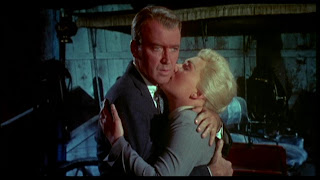 Also recommended from director Alfred Hitchcock:
"Just like in many of his films, in Dial M for Murder (1954) Hitchcock heightens the suspense by subversively enlisting our sympathies for the villain. Nobody in their right minds would wish for the lovely Grace Kelly to be murdered, but somehow we are manipulated into almost hoping that Tony's plan is a success, and we revel in his sly brilliance as he recovers from his initial failure to implement an equally-devious Plan B. By doing this, Hitchcock makes the audience feel as though they are, themselves, a part of the crime, and as though their own fates hinge on the outcome of Chief Insp. Hubbard's (John Williams) investigation."
"A lesser director might have baulked at the task of making a continually-suspenseful 96-minute film set entirely in a lifeboat. Hitchcock, however, used the situation to his advantage, and the tiny set on which Lifeboat (1944) was filmed (allegedly the smallest in film history), creates a constricting, claustrophobic atmosphere. The surrounding ocean landscape, presumably simulated using the director's favoured rear-projection, is surprisingly convincing throughout... During filming, the cast members were exposed to the elements, which aided the realism of their performances, but also led to frequent illnesses such as seasickness and pneumonia."
"Foreign Correspondent (1940) is most fondly-remembered for its various incredible set-pieces, and the dramatic/romantic subplots that link them are almost immaterial. Your heart will pound during the assassination in the rainswept street; your heart will stop as Jones creeps silently and perilously through the enemy-occupied windmill; your heart will explode as the trans-Atlantic clipper dives terminally into frigid depths of the ocean, cascades of seawater charging through the cockpit of the aircraft. The resultant sequence on the floating aircraft wreckage would no doubt influence Hitchcock when he directed Lifeboat (1944), one of many moments in which Paul Eagler's visual effects left me speechless."

Read More...
Summary only...
 Wajda's film opens with an cold-blooded ambush, in which two concrete factory workers are needlessly gunned down in a case of mistaken identity. These shootings take place at the front steps of a country chapel, and with a child within earshot, highlighting the heartless resolve with which the Home Army rebels carry out their murders. However, despite the pro-Communist climate in which Wajda produced his film, he stops well short of demonising the "enemy" rebels, and, indeed, young Maciek is portrayed as the tragic victim of the story. In fact, the film goes to some length to emphasise the parallels between Maciek and Communist leader Szczuka (Waclaw Zastrzezynski), implying the needlessness of their conflict, and so the tragedy of their fatal opposition: both men fought valiantly against fascist dictatorships (the former in both Spain and Poland), and remember fondly the war comrades who died in pursuit of an ideal that, to both, should now be deemed realised. Instead, Szczuka dies in Maciek's arms as Poland celebrates its liberation.
 Polish cinema reached its peak in the late 1950s, following the Khrushchev Thaw that saw an ease in Soviet censorship, and Andrzej Wajda was at the forefront of this cinematic New Wave. Jerzy Wójcik's stark black-and-white cinematography is elaborate and beautifully-executed, capturing the main character's claustrophobic isolation using closed sets and a cramped frame. The war itself took many prisoners, but Maciek – ironically a "freedom fighter" – finds his freedom restrained in a less overt manner. Even with the liberation of Poland, Maciek is obligated to continue his blood feud, denied the ordinary happiness offered by a life with pretty bar-maid Krystyna (Ewa Krzyzewska), with whom he spends a night. Cybulski's character squanders most of the film in boisterous, overcrowded surroundings, finding room to move only in fractured moments, such as a late-night stroll through the crumbling town ruins. Even in his death throes, Maciek stumbles through a cluttered wasteland of garbage, ultimately joining the detritus of the twentieth century's most costly conflict.


 Also recommended from director Orson Welles:


_poster.jpg)


