TSPDT placing: #737
Directed by: Samuel Fuller
Written by: Dwight Taylor (story), Samuel Fuller (screenplay)
Starring: Richard Widmark, Jean Peters, Thelma Ritter, Murvyn Vye, Richard Kiley, Willis Bouchey, Milburn Stone
WARNING: Plot and/or ending details may follow!!! [Paragraph 2 only]
Shock Corridor (1963) was my first film from Samuel Fuller, and there I was impressed with the director's astute blending of B-movie and big-budget aesthetics, even if the story itself was pure schlock. Pickup on South Street (1953) was released a decade earlier in Fuller's career, obviously produced on a larger budget from a big-name studio, Twentieth Century-Fox. Nevertheless, the visuals are still notable in that there's a somewhat raw, naturalistic element to the photography, not unlike Dassin's Night and the City (1950) and Kazan's Panic in the Streets (1950) {the latter was also shot by cinematographer Joe McDonald}. In some scenes, Fuller shoves the camera so close to his actors' faces that they're out of focus, bluntly registering the intimate thoughts, emotions and brief inflections that are communicated through that most revealing of facial features, the eye. Though (unexpectedly) prone to melodrama, and with just a hint of anti-Communist propaganda, Pickup on South Street is a strong film noir that succeeds most outstandingly in its evocation of setting – the underground of New York City.
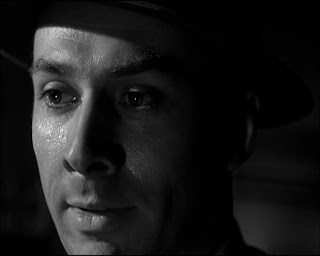 When just-out-of-prison pickpocket Skip McCoy (Richard Widmark) snags the purse of a woman on the subway (Jean Peters), he pockets more than he'd originally bargained for. The woman, Candy, and her cowardly ex-boyfriend Joey (Richard Kiley) had been smuggling top-secret information to the Communists, and McKoy has unexpectedly retrieved an important roll of micro-film. Will he turn in the MacGuffin to the proper authorities, or sell it to the highest bidder? If Pickup on South Street has a flaw, it's that the story seems designed solely to bolster an anti-Communist agenda, reeking of propaganda like nothing since WWII {Dwight Taylor, who supplied the story, also notably wrote The Thin Man Goes Home (1944), the only propagandistic movie of the series}. For no apparent reason, every identifiable character – even the smugly self-serving Skip McCoy – eventually becomes a self-sacrificing patriot, the transformation predictable from the outset. In traditional film noir, the unapologetic criminal always gets his comeuppance, the rational punishment for his sins, but apparently not when they've served their country; patriotism wipes the slate clean.
 Richard Widmark, an actor who I'm really beginning to like, plays the haughty pickpocket with composure, though always with that hint of ill-ease that suggests he's biting off more than he can chew. The opening scene on the train is the film's finest, as McCoy breathlessly fishes around in his victim's hand bag, recalling Bresson's Pickpocket (1959). Thelma Ritter is terrific as a tired street-woman who'll peddle information to anybody willing to pay for it (though, of course, she draws the line at Commies). Jean Peters is well-cast as the trashy dame passing information to the other side, playing the role almost completely devoid of glamour; Fuller reportedly cast the actress on the observation that she had the slightly bow-legged strut of a prostitute. Nevertheless, Peters must suffer a contrived love affair with Widmark that really brings down the film's attempts at realism. Fascinatingly, upon its release, Pickup on South Street was promptly condemned as Communist propaganda by the FBI, and the Communist Party condemned it for being the exact opposite. Go figure.
7.5/10
Currently my #5 film of 1953:
1) From Here To Eternity (Fred Zinnemann)
2) Stalag 17 (Billy Wilder)
3) I Confess (Alfred Hitchcock)
4) The Titfield Thunderbolt (Charles Crichton)
5) Pickup on South Street (Samuel Fuller)
6) Roman Holiday (William Wyler)
7) The War Of The Worlds (Byron Haskin)
2) Stalag 17 (Billy Wilder)
3) I Confess (Alfred Hitchcock)
4) The Titfield Thunderbolt (Charles Crichton)
5) Pickup on South Street (Samuel Fuller)
6) Roman Holiday (William Wyler)
7) The War Of The Worlds (Byron Haskin)

 Like any good B-movie should, Shock Corridor (1963) builds itself upon a shaky and unlikely premise. Johnny Barrett (Peter Breck, who reminds me of a young Martin Sheen) is a hot-shot journalist with aspirations towards the Pullitzer Prize. In order to crack an unsolved murder in a psychiatric hospital, Barrett offers to have himself committed, fooling police and doctors into believing that he has made incestuous advantages towards his sister– actually his long-time girlfriend, Cathy (Constance Towers). There are, of course, unaddressed hurdles in this ridiculous scheme: why would the authorities never bother to verify Cathy's true identity? However, once Barrett gets inside the mental ward, we're so fascinated by its peculiar brand of loonies that we don't ask any further questions. The supporting performances vary greatly in subtlety and credibility, but there's no doubt that they hold our attention, prone to unexpected violent outbursts and momentary reclamation of their sanity. Barrett's murder investigation is straightforward and episodic: he merely befriends each of the three witnesses in turn, and waits for them to come to their senses.
 This being my first film from Samuel Fuller, I'm not sure whether or not his films typically have underlying political messages. However, Shock Corridor is certainly a confronting critique of the American mental health system; indeed, how can the mentally ill ever recover if even a sane man loses his sanity after just several months in such an institution? I was tempted to think that Barrett's mental deterioration was based on the findings of the disastrous Stanford Prison Experiment, in which human behaviour was drastically influenced by one's appointed status as either a "guard" or a "prisoner." Then I remembered that Zimbardo's study wasn't undertaken until 1971, which makes Fuller's conclusions even more audacious and groundbreaking. The film was shot by cinematographer Stanley Cortez, who also worked on The Magnificent Ambersons (1942) and The Night of the Hunter (1955), who superbly blends the raw, gritty aesthetic of low-budget schlock with the surreal, distorted visuals of big-budget film noir. Call it bold, call it outrageous, call it ridiculous –but there's no doubting that Sam Fuller is a director to watch.
 What others have said:


_poster.jpg)


