TSPDT placing: #321
Directed by: William Wyler
Written by: Lew Wallace (novel), Karl Tunberg (screenplay), Maxwell Anderson, Christopher Fry, Gore Vidal
Starring: Charlton Heston, Jack Hawkins, Haya Harareet, Stephen Boyd, Hugh Griffith, Martha Scott, Cathy O'Donnell, Sam Jaffe, Finlay Currie, Frank Thring, Terence Longdon, George Relph, André Morell
 Watching Ben-Hur (1959) is a lot like paying a visit to the Colosseum. Situated in Rome, Italy, this massive elliptical amphitheatre is the largest ever built in the Roman Empire, able to seat up to 80,000 spectators for gladiatorial games and various public spectacles. I've never been to Rome myself, but I'd imagine that one would look up at this amazing feat of ancient architecture, and be left in awe at the scale of it all. You would marvel at the amount of care and labour that must have gone into such a project, particularly given the comparatively primitive tools with which the builders had worked. I feel the same way about Ben-Hur – William Wyler's epic of epics, and, at the time, the most expensive film ever made. Winner of eleven Academy Awards, including Best Picture, this colossal cinematic gamble resurrected M-G-M from financial ruin. But is it worth nearly four hours of your time? Like a lumbering elephant, Ben-Hur wallows in its immensity, extravagance and self-importance. But it is epic – oh, so very epic! – and, like the Colosseum, demands our awe.
Earlier this year, I decreed Ben-Hur to be the one film that I wouldn't watch for the first time until I had the luxury of viewing it at the cinema. Sooner than expected, the opportunity came along, though the Christmas Eve screening date made it essential that I bring the usual holiday festivities forward one day. The sacrifice was much warranted, for the film can only be fully experienced in the movie theatre, not least because of the breathtaking 70mm anamorphic print, with an aspect ratio of 2.76:1 – one of the widest ever made. William Wyler fills every frame with rich extravagance, such that even the quietest person-to-person conversation takes place in a magnificent, lavishly-decorated chamber. Such expansive surroundings often promote coldness and detachedness from the audience (many uninvolving historical epics were produced around this period), and Ben-Hur doesn't entirely escape the same fate; for every exciting and emotional sequence, there are maybe two scenes of negligible exposition. But the film thrives on its excesses, and, fortunately, the good scenes are so incredibly good that they merit the wait.
 Charlton Heston won an Oscar for his portrayal of Judah Ben-Hur, though his performance is merely adequate without being particularly brilliant. Heston, an actor who flourished mostly on sheer charisma, I think, appears to struggle in the film's most emotional moments {my personal pick for the award that year would have been Laurence Harvey in Jack Clayton's Room at the Top (1959)}. Stephen Boyd, though un-nominated, is quite terrific as Messala, Judah's boyhood friend who was later corrupted by the evils of the Roman Empire. Though there are many exciting scenes – such as the fiery ocean battle or Christ's crucifixion – the film's undisputed centrepiece is, of course, the extraordinary chariot race, a marvel of adrenalin-charged action and suspense. Every single metre of the contest had me enthralled, every jolt and tremble of the carriage sending an agitated chill down my spine. The sequence's enduring influence is to be found in practically every historical epic that followed, most noticeably Ridley Scott's Best Picture-winning Gladiator (2000).
To be denied one's name is the film's greatest tragedy. When condemned to a lifetime of slavery aboard a Roman galley, Judah loses his important status and is delegated a generic identification number – #41. His mother and sister, having contracted leprosy after years in confinement, later flee to a leper colony, where, we are told, names are of no use. After being liberated from captivity by the kindly nobleman Quintus Arrius (Jack Hawkins), Judah takes on the name of his newly-adopted father, a compassionate gesture but one that he is later ashamed to have accepted. To be denied one's face, on the other hand, is apparently divine. Claude Heater, as Jesus Christ, is never properly seen, glimpsed only from behind or at a distance. In this way, the Messiah is portrayed as something holy and angelic, not to be glimpsed by mortal eyes. Though the story of Christ may only form a subplot, thematically it sits at the film's heart. Ben-Hur is about the beginnings of Christianity, and how its teachings have inspired people from the very beginning, and ever since.
7.5/10
Currently my #8 film of 1959:
1) Die Brücke {The Bridge} (Bernhard Wicki)
2) Room at the Top (Jack Clayton)
3) North by Northwest (Alfred Hitchcock)
4) Some Like It Hot (Billy Wilder)
5) On the Beach (Stanley Kramer)
6) Le Quatre cents coups {The 400 Blows} (François Truffaut)
7) Pickpocket (Robert Bresson)
8) Ben-Hur (William Wyler)
9) The Tingler (William Castle)
10) Some of Manie’s Friends (Bob Finkel) (TV)

 John Huston's rousing adventure was largely filmed on location in Africa, though many of the white-water sequences were obviously shot before a rear-projection screen in London; fortunately, these optical effects are far less distracting on a cinema screen. It can often be problematic to build almost an entire film around just two characters, but Bogart and Hepburn are clearly up to the challenge, sharing a chemistry that is infectiously entertaining. Whether they're engaged in awkwardly-formal conversation, at each other's throats, or falling in love, every line of dialogue (from a screenplay by John Huston and James Agee) is an absolute delight, all the more so because we know that Charlie and Rose will eventually end up in each other's arms. At either end of the adventure, Robert Morley lends some pathos to the tale as Rose's humble missionary brother, who dies following a German raid; and Peter Bull, though perhaps too cartoonish to entirely fit the film's overall tone, adds some lighthearted humour as a temperamental enemy captain.
 Just what is it about The African Queen that has made it such an enormous viewer favourite? I think that much of this has to do with Huston's predominantly lighthearted approach to the material – if you're not gripping your seat in excitement, then you're laughing at the interactions between the two leads. However, there's also a less-pronounced political commentary at play. Reverend Sayer's death might been viewed as symbolising the inevitable death of British Colonialism. That Bogart's roguish, hard-drinking North American (he's actually a Canadian) effectively conquers the prudishness of Hepburn's formal British spinster may likewise be taken to foreshadow the United States' rise as the world's most influential superpower. All politics aside, I find it amusing that just last week I attended a cinema screening of Francis Ford Coppola's
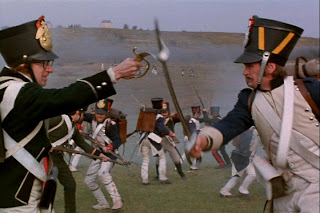
 Love and Death (1975) was obviously produced shortly after an Ingmar Bergman marathon, and the film is both an affectionate homage and an enjoyable spoof of The Seventh Seal (1957), Bergman's memorable meditation on the nature of religion and death. The perfect bittersweet ending sees Death, cloaked in a white sheet, leading our hero in a Danse Macabre across the countryside. Also targeted by Allen's razor-sharp flair for parody are the epic Russian novels of Dostoyevsky and Tolstoy, such as "Crime and Punishment," "The Idiot" and "War and Peace." A singularly-absurd recreation of the Battle of Waterloo, which – among other anachronisms – is catered by a New York hot-dog vendor, is also an amusing send-up of Sergei Bondarchuk's impressive box-office disaster Waterloo (1970), and even Bonaparte himself makes a surprise appearance as both an assassination target, and to demand the completion of the pastry to be named in his honour {we call them vanilla slices down here in Australia}.
 Woody Allen and Diane Keaton, in their third of many collaborations, work together perfectly as cousins (and later partners) who like to bicker endlessly about the meaning of life, their conversations descending swiftly into dubious pseudo-philosophical ramblings of which I was able to make neither head nor tail. With the exception of one bottle gag that wouldn't have been out of place in a Chaplin film, most of the humour is purely verbal, and Allen even experiments with breaking the fourth wall, a style of comedy that he would implement with astonishing success in Annie Hall. In terms of story, Love and Death, in spite of its episodic nature, comes together more completely than any of Allen's previous films, and the jokes are consistently funny enough to draw a laugh. Considerably funnier than that other famous historical comedy released in 1975 (if I may be so bold), this is one of Woody Allen's funniest movies, with more than enough intelligent humour to go around.
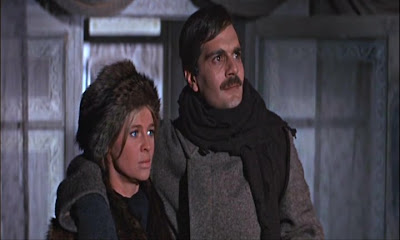 If any director was most suited to adapt "Doctor Zhivago," Boris Pasternak's mighty retelling of a difficult era in Russia's history, it was, indeed, David Lean. As was the case in his previous film, the plot itself comes second to the director's astonishing ability to capture the majesty of every instant, and to place the audience in the midst of the moment. As such, Doctor Zhivago (1965) lacks any straightforward narrative, but its strength is drawn from the incredible emotion that accompanies each turn in events: it's a story of love, loss, hope, war, family, revolution and death… basically, everything that makes life worth living. Yuri Zhivago (Omar Sharif) stumbles passively through the turmoil that is Russia during the 1910s, both before and after the onslaught of WWI, and through his submissive eyes we watch citizens acclimatise to the constantly-shifting political climates of the era. During the Revolution of 1917, and the subsequent Russian Civil War, one's very existence was forever in doubt, and the uncertainty of the times consistently casts an ominous shadow over the fate of the film's major characters.
 Filming for Doctor Zhivago, as was the case in Lawrence of Arabia, was a long and gruelling experience for all involved. As Pasternak's novel was still banned in the Soviet Union at the time of the film's production {it would not be officially published there until 1988, though several earlier samizdat editions could be found}, filming took place primarily in Spain, with several sequences also shot in Finland and Canada. This extensive location-shooting allowed Lean to accurately reproduce the splendour of the Russian wilderness: the bitter cold of the snow-swept winter landscapes, the vibrancy of the fresh and chilled summers. An entire Moscow city-block was recreated just outside Madrid, and it would take a sharp eye to discern that the icy cobbled streets of the film's opening act are not located in the Russian capital. Such are the scenes' authenticity that you shiver at the very thought of stepping outside into the falling snow, and, as Zhivago – encrusted in a numbing case of ice – trudges stiffly through the winterscape, we can almost feel our own limbs becoming numb with frostbite.
 Rarely has an epic delivered such an impressive display of acting performances. Omar Sharif, who was apparently surprised to have landed the lead character in David Lean's latest, doesn't initially strike one as being "leading man" material, but it is his passiveness in the role that proves crucial to the telling of Pasternak's story. He wanders dutifully through the changing landscape of Russia, rarely saying what he truly believes, and never displaying any genuine outbursts of emotion; he is a ghost of a person, and simply perseveres through his belief that better times are yet to come. Zhivago's primary emotional outlet is through his poetry, through which he articulates his passions and anguishes, though he only finds himself able to write when he finds himself in a comfortable living situation. His work has been condemned by the government for focusing on personal sentiments rather than the "good of the state," an ironic foreshadowing of the censorship that Pasternak himself would encounter. Nevertheless, Zhivago comes across as quite a cold and detached character, and there's a selfishness inherent in his decision not to pursue his estranged family to Paris.
 Julie Christie provides the film's primary love interest, an abused and neglected woman in whom Zhivago finds an illicit companionship. Independent, and yet very vulnerable, Lara forms the emotional core of the story, and it is through her association with the lead character that he is able to divulge his true feelings and pen his finest work. Geraldine Chaplin (for better or worse, a spitting image of her father) is also quite good as Zhivago's wife, Tonya, though her presence – perhaps intentionally – fails to evoke the same glamour and compassion as is the case with Lara. Rod Steiger, who has been greatly impressing me of late, is a slimy figure of egotism and malevolence ("...and don't delude yourself this was rape, that would flatter us both"), though his deeds in the film's final act raise a level of ambiguity that is interesting to ponder: why, indeed, did he arrive to offer Lara warning? The motives of Gen. Yevgraf Zhivago, played by the great Alec Guinness, are similarly uncertain, and his apparent detachedness - almost indifference - to the plight of his half-brother is a puzzling riddle that only a second viewing could possibly resolve.
 William Keighley was the picture's original director, but – perhaps due to illness, or because the studio wanted to "spice up" the action sequences – he was later replaced by Michael Curtiz; both men received on screen credit. With an epic budget of $200 million, the 'The Adventures of Robin Hood' was reportedly the most expensive ever made, but proved a major success for the studio, who immediately cast Flynn and co-star Olivia de Havilland in another two Technicolor epics {the Western Dodge City (1939) and The Private Lives of Elizabeth and Essex (1939)} – the pair had already starred together in two films previously, both directed by Michael Curtiz. Olivia de Havilland is sweet and elegant as Maid Marian, though I daresay that much of her beauty goes to waste hidden beneath a headpiece, which she only removes for one scene.
 Whether he's swinging gleefully from a rope, or splitting his opponents' arrows in two, Errol Flynn's Robin Hood is a hero that the audience can really cheer for. He can be a rascal at times, and has a haughty chuckle that infuriates his enemies, but, when the time calls for it, he can be suitably serious and determined, not to mention unflinchingly patriotic. It's the role that Flynn will always be remembered for. The film's two major villains are played with wicked charisma by Claude Rains, as the treacherous Prince John, and Basil Rathbone {before he immortalised himself playing Sherlock Holmes} as Robin Hood's sleazy romantic competitor, Sir Guy of Gisbourne. Screenwriters Norman Reilly Raine and Seton I. Miller play heedlessly with British history, but to adhere strictly to the facts would have been to rob the film of its fanciful, good-natured charm.
 This film was not the first to feature the adventures of England's favourite folk hero; Robin Hood had appeared in no less than ten films previously, though Douglas Fairbanks's 1922 incarnation is the only popularly-known example. Countless subsequent versions have followed, but few have even come close to approaching Flynn's dashing portrayal of the master marksman. The Adventures of Robin Hood is certainly not the most sophisticated film you'll see from 1938 {Michael Curtiz's Angels with Dirty Faces (1938) is currently my favourite}, but it's just so jam-packed with action, comedy and romance that it's difficult to find another film that delivers so effectively in sheer entertainment.
 Only Angels Have Wings was filmed in Los Angeles, and does an excellent job of evoking the exotic tropical environment of South America. The characters always appear beleaguered by the overwhelming heat and humidity of the Ecuadorian jungle, and the frequent storms bombard the landscape with stifling fog and rain. The scenes of aviation, largely produced using elaborate model-work, remain mostly convincing, and those few shots that aren't have a likable charm about them. Roy Davidson (photographic) and Edwin C. Hahn (sound) received an Academy Award nomination for their special effects work, the first time that an Oscar had been offered in that category. One particular aviation shot, apparently involving no effects of any kind, follows Richard Barthelmess' mail-plane as he attempts an extremely risky landing on a perilous plateau. Filmed from adjacent aircraft, the long shot follows the plane as its swoops around the makeshift runway and comes in for the landing, coming to a stop just metres from the edge of the cliff. It's an elaborate and meticulously-staged moment that really makes you appreciate what cinema is all about.
 The story involves Geoff Carter (Cary Grant), who manages a air-mail business from the small port-town at Barranca. Though he has been romantically-involved with many women, Geoff has basically given away all chances of happiness, being unwilling to place any woman through the stress and fear that besieges any wife whose husband has such a dangerous occupation. Spirited and intelligent Bonnie Lee (Jean Arthur) arrives at the town, and, despite her initial aversion towards Geoff, slowly finds herself caring about him. Geoff's repeated attempts to rebuff Bonnie's advances ultimately prove futile, and he discovers that the woman who truly loves him will never allow herself to be affected by his rejections, however selfless and noble his intentions. Forming the film's dramatic heart is the character of Bat Kilgallen (Richard Barthelmess), a disgraced pilot who finds himself aggressively slighted by his comrades for ejecting from his aircraft and leaving his navigator, the brother of Kid Dabb (Thomas Mitchell), to die. Even when offered only the most dangerous missions, Kilgallen's unwavering desire for redemption earns him the respect of those who had formerly denounced him as a coward.
 If I ever had any doubts that Akira Kurosawa was my kind of film director, then I may now consider them groundless. After two solid but flawed efforts in Stray Dog (1949) and
 Akira Kurosawa, working with cinematographers Fyodor Dobronravov, Yuri Gantman and Asakazu Nakai, has committed to celluloid some of the most strikingly-gorgeous images since David Lean's Lawrence of Arabia (1962). The wilderness of Siberia is, at first glance, exceedingly mundane and unremarkable, but, out of the sheer isolation and purity of the landscape, Kurosawa uncovers a noble beauty about the trees, rocks, waters and, indeed, the people who survive there. The film's most breathtaking shot shows Arsenyev and Dersu perched before a pristine sunset, the pair perfectly-framed between the blazing red Sun and the ascending Moon. Out of a bitter windstorm on the frozen expanses of a lake, Kurosawa crafts an intense episode of nail-biting suspense, as the two frantically attempt to gather grass for the purposes of constructing a crude but vital sleeping shelter, their only opportunity to avoid freezing to death in the relentless cold of the Siberian night. Recognising the inherent beauty in the landscape he was photographing, Kurosawa often makes excellent use of long takes, allowing the viewer to simply sit back and absorb the majesty of the wilderness with which he has been surrounded.
 Another important theme in Dersu Uzala is the cultural and environmental toll of progress. It was only during the early years of the 1900s that the Sikhote-Alin region of Siberia began to abandon its old-time traditions and lifestyles in order to catch up with the more advanced civilisations that surrounded it. Dersu, who has lived alone in the forest for much of his life, proves a final victim of society's progress, a tragic symbol of a culture that has been irretrievably lost in the past. With his dwindling eyesight, and an escalating superstitious paranoia of the forest caused by his senseless murder of a tiger, Dersu finds that he can no longer provide for himself, and so accompanies Arsenyev back to his home in the city. His spirit crushed and broken, Dersu spends his days staring soullessly into the burning fireplace, consumed by memories of his lifetime in the free and peaceful isolation of the forest. He eventually resolves to return to the wilderness, but is shortly murdered for his expensive rifle; the lone hunter has now been completely destroyed by the unstoppable march of progress, which brings along both its benefits and its unavoidable evils.
 Howard Hawks, perhaps Hollywood's most versatile master director, was a considerable fan of author Ernest Hemingway, but didn't think all too highly of his 1937 effort, "To Have and Have Not." Taking it upon himself to improve the story, Hawks set his writers upon Hemingway's "bunch of junk," and created what is considered by some to be one of his best films. With its abundance of pistol-clad gangsters and Bogart's legendary noble tough-guy, comparisons with other pulp film-noirs {such as The Maltese Falcon (1941) and Hawks' own The Big Sleep} are perfectly justified, as are the noticeable parallels with Michael Curtiz's
 What ultimately separates a good film like To Have and Have Not from a masterpiece like, say, Casablanca, is the depth of the characters. By the end of the latter film, we feel as though we've known Rick (Bogart) and Ilsa (Ingrid Bergman) for their entire lives, and we feel pain for their romantic sorrows. Howard Hawks has always been more concerned with witty dialogue than character development, and, though there's no doubting the sheer entertainment of his pictures, they are rarely able to strike a chord close to the heart. Most of this film's characters are little more than two-dimensional caricatures, and the camera, in order to avoid distracting from the excellence of the screenplay, does little of any interest. To Have and Have Not is certainly a solid film, but it's not exactly "exciting" film-making, with the exception, of course, of the coupling of Bogart and Bacall, which was a stroke of genius on Hawks' part. Also notable is the musical soundtrack, with Hoagy Carmichael appearing as a hotel piano player to perform “Hong Kong Blues,” and Bacall singing “How Little We Know.”

 Intertwined within this darkly-themed tale of obsession and prejudice is a somewhat awkwardly-placed romance between Martin and Laurie Jorgensen (Vera Miles), one that belongs in a lesser Western to this one. The selection of eccentric supporting characters, including those played by Ward Bond, Hank Worden and Ken Curtis, certainly provide some amusement for the audience, but ultimately detract from the murky themes that comprise the heart of the story, of Ethan’s endless search to retrieve his niece from the Comanches; or, otherwise, to purge her “pollution” through murder. As far as Weste


