TSPDT placing: #265
Directed by: Robert Aldrich
Written by: Mickey Spillane (novel), A.I. Bezzerides (writer)
Starring: Ralph Meeker, Albert Dekker, Paul Stewart, Marian Carr, Maxine Cooper, Cloris Leachman
WARNING: Plot and/or ending details may follow!!!
Robert Aldrich's Kiss Me Deadly (1955) opens with one of the most captivating sequences I've seen in a long while. Dispensing with the credits until a later date, when they scroll slanted and backwards across the screen, the film fades directly into a pair of naked feet fleeing along a roadway, the soundtrack dominated by her amplified breathing and panting, the flicker of passing automobile headlights briefly illuminating her anguished facial features. A passing motorist swerves to avoid the barely-clothed woman, skidding dangerously onto the gravel, and the disgruntled driver, private investigator Mike Hammer (Ralph Meeker), reluctantly offers her a ride. The credits roll over images of the road ahead, filmed from the backseat of Hammer's convertible, to the soundtrack of Nat King Cole's "Rather Have the Blues" on the radio, the mysterious woman's sobbing and breathing still disconcertingly audible. I was immediately transfixed by Aldrich's directing style - gritty, mean, and yet still very professional - and, had the film maintained this tone for the entirety of its running time, I would have proclaimed Kiss Me Deadly to be no less than a masterpiece.
 It doesn't take long, however, for the film to fall into the familiar trappings of a pulp detective novel, not unlike your typical Raymond Chandler or Dashiell Hammett adaptation. This isn't necessarily a damaging characteristic, and the film very much retains its ability to thrill and entertain, but it loses the raw grittiness that, stylistically, made the prologue sequence so damn gripping. The remainder of the story, creatively adapted from a novel by Mickey Spillane, interestingly blends two distinct genres: on the one hand, it's a hard-boiled pulp detective story, complete with a hard-edged private investigator, seedy villains and a scheming femme fatale. On the other hand, it's a science-fiction off-shoot of the Cold War, with a destructive, possibly-nuclear Macguffin for which the film's characters are quite willing to kill. Ralph Meeker is ideally-cast as Mike Hammer, a wry, stubborn and selfish detective whose inability to cooperate with the unsympathetic authorities can only lead to apocalypse. The screenplay by A.I. Bezzerides, like many noirs, carries a streak of misogyny, with even the innocent girls (including Maxine Cooper and Cloris Leachman) being neglected and abused at every turn.
 Kiss Me Deadly is also interesting in that the filmmakers have obviously become very aware of typical film noir conventions, and the inclusion of the mysterious Pandora's Box - knowingly referred to as "the great whatsit" - is a deliberate satire of what Alfred Hitchcock had called the MacGuffin, a plot device that motivates the film's characters, but the details of which are of little or no importance. The influence of this device can be seen in numerous subsequent pictures, from the opening of the Ark of the Covenant in Steven Spielberg's Raiders of the Lost Ark (1981) to the mysterious glowing briefcase in Quentin Tarantino's Pulp Fiction (1994). The DVD release of Kiss Me Deadly includes the film's restored original ending, in which Hammer and Velda escape into the crashing waves, their futures nonetheless still uncertain, as the apocalyptic nuclear device destroys the seaside cottage in a blinding mushroom cloud. I much preferred it to the abrupt, truncated ending that had previously been present in most prints, and Aldrich himself confirmed that he had no part in the somewhat-crude chopping of his film's conclusion.
8/10
Currently my #4 film of 1955:
1) Du rififi chez les hommes {Rififi} (Jules Dassin
2) The Ladykillers (Alexander Mackendrick)
3) Bad Day at Black Rock (John Sturges)
4) Kiss Me Deadly (Robert Aldrich)
5) Nuit et brouillard {Night and Fog} (Alain Resnais)
6) Les Diaboliques (Henri-Georges Clouzot)
7) Rebel Without a Cause (Nicholas Ray)
8) The Night of the Hunter (Charles Laughton)
9) The Trouble with Harry (Alfred Hitchcock)
10) Killer’s Kiss (Stanley Kubrick)
 National Film Preservation Board, USA:
* Selected for National Film Registry, 1999
What others have said:
"Kiss Me Deadly really didn't resurface in the cinema consciousness until the early 1970s when the French term film noir broke into American film journals. It suddenly appeared in a pantheon of top titles that included Double Indemnity, The Big Sleep, Touch of Evil and Out of the Past. Previously ignored as an irrelevant addendum to Mickey Spillane's culturally abhorred world of tough guy pulp fiction, Robert Aldrich and screenwriter A.I. Bezzerides' film was heralded as an extreme expression of protest against 1950s conformist complacency. It subverted Spillane by criticizing his brutal avenger Mike Hammer as greedy, narcissistic and infantile."
Glenn Erickson - Noir of the Week, 2007
"It's a thrilling ride through the criminal dregs and overlords of 50s Los Angeles. Even the period detail - from one-piece bathing suits to an enormous, wall-mounted reel-to-reel answer machine - is a joy. But this movie stands, unequivocally, on its merits. Masterful accumulation of tension is accompanied by a smouldering performance from Maxine Cooper as Hammer's assistant and lover, Velda. Ralph Meeker is electric in his understated portrayal of Hammer, the calculating anti-hero; who knows why he never really hit the big time?"
David Mattin - BBC Movies, 2006
"Producer/director Aldrich's brutal, fast action, paranoid film with a series of disconnected scenes, was based upon pulp fiction writer Mickey Spillane's 1952 sensationalist detective best-seller of the same name... The film is a low-budget, B-grade film (at a cost of about $400,000) without recognizable actors. As a counterpoint to the hard-boiled film, cultural allusions abound: the Christina Rossetti poem "Remember," and a Caruso vocal recording - to name a few. Its posters heralded: BLOOD-RED KISSES, WHITE-HOT THRILLS!... Kiss Me Deadly is rich with symbolic allusions, labyrinthine and complex plot threads, and Cold War fear and nuclear paranoia about the atomic bomb. The film, shot over a one month period in late 1954, is a masterpiece of cinematography, exhibited in the disorienting camera angles and unique and unconventional compositions of Ernest Laszlo. It has all the elements of great film noir - a stark opening sequence, destructive femme fatales, low-life cheap gangsters, an anti-hero, expressionistically-lit night-time scenes, a vengeful quest, and a dark mood of hopelessness."
Tim Dirks - Filmsite
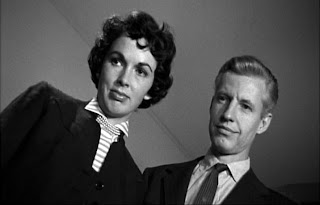

Other classic film noir:
"Who killed Owen Taylor, the replacement chauffeur? I don't know; Philip Marlowe doesn't know; screenwriters William Faulkner, Leigh Brackett and Jules Furthman certainly don't know. Indeed, even Raymond Chandler, the author of the original novel, was once asked to explain his story's many murders, double-crossings, twists and turns, and replied that he had absolutely no idea. In any other situation, I might consider this a solid detraction from the quality of the film, but, strangely enough, here it almost acts as a positive. The Big Sleep (1946) is so doggedly obsessed with showing us the dark, seedy underbelly of human existence that any scenario, however shocking, is quite conceivable; the murderer could have been any one of the characters, and this would have been wholly consistent with the general tone of the film."
"In a Lonely Place (1950) has only now been lauded as one of the finest entries into the film-noir movement, and Humphrey Bogart's performance has emerged as among the most intense and profound in his distinguished repertoire. A brooding study of aggression, trust and success, Ray's film meticulously deconstructs the Hollywood myth, revealing a frightening world where the man you love could very well be a murderer... It's this notion of creativity – or, rather, the lack of creativity in film-making – that forms the heart of In a Lonely Place. There's no doubt that Dixon Steele is a talented screenwriter, but his reluctance to allow his work to be influenced by popular opinion makes him feel trapped and alone, as though Hollywood is attempting to stamp out his genius. His frustration with the film-making business is allowed to accumulate steadily within, before being unleashed in adrenaline-charged explosions of aggression and violence."
"One might suggest that Welles did everything possible to ensure that The Lady from Shanghai (1947) would fail at the box-office: he filled the screen with bizarre, unlikable characters, and effectively diluted the star-appeal of then-wife Rita Hayworth by shearing and dyeing her famous red hair... The film's climax is absolutely unforgettable, a gripping and innovative shoot-out in a carnival house of mirrors. As each character blasts away at illusory images of their enemies, the bullets shatter their own reflected profiles, fulfilling Michael's foreshadowing anecdote that compares Elsa (Hayworth) and Arthur (Everett Sloane) to sharks gnawing feverishly at their own flesh."

Read More...
Summary only...


 Science-fiction has often tackled the notion that Mankind's technology is destined to rebel, as in 2001: A Space Odyssey (1968). However, unlike most entries to the genre, T2: Judgement Day takes the time to explore the idea. As in Kubrick's film, the fates of humans and machines become inescapably entwined: Man is no longer merely the designer (a la Dr. Frankenstein) who creates an artificial son, but one who must learn from his progeny. Accordingly, John Connor (Edward Furlong) and the Terminator (Arnold Schwarzenegger) share a father-son relationship that twists back on itself like a Moebius strip, each half teaching the other. In one haunting sequence, Sarah Connor (Linda Hamilton) grimly contemplates the Terminator's unwavering loyalty towards John, and his ironic suitability as a father figure. This grotesque interlacing of familial roles speaks a clear message: if Judgement Day is to be averted, Man and Machine must coexist as equals, though human vanity may never allow it.
 Throughout the film, Cameron weaves one astonishing action set-piece after another, utilising a seamless combination CGI and optical trickery. The T-1000 Terminator at first glance seems reasonably innocuous, but Robert Patrick brings something icily sinister to the role, a cold intelligence that isn't strictly mechanical but somehow filled with imagination. An equally fascinating character, I thought, was Linda Hamilton's Sarah Connor, a complete reversal from the innocent Sarah Connor of the previous film. Now emotionally hardened by the prospect of nuclear holocaust, Sarah sees only ghosts where she once saw people, her apathy stemmed only by her maternal instincts towards John. In a haunting dream sequence, Sarah Connor is powerless to warn a younger version of herself (representative of society at large) of the coming dangers, her screams consumed by a nuclear blast that levels cities and engulfs her in flames. Hamilton's performance is bold and ferocious, perhaps cinema's most intense female action role (not coincidentally, James Cameron also provided us with the runner-up, Ellen Ripley (Sigourney Weaver) in Aliens).
 Considering the director's association with low-budget schlock, I had expected a film with unquestionably shoddy production values. Instead, 'The Tingler (1959)' is impeccably shot by Wilfred M. Cline and generally well-written (Dr. Chapin referencing both his wife and a stray cat: "Have you two met? In the same alley, perhaps?"). Horror icon Vincent Price is the film's charismatic star, but excellent supporting performances are given by Judith Evelyn as a deaf and dumb cinema owner, Philip Coolidge as her anxious husband, and Patricia Cutts – sexy and acerbic – as Dr. Chapin's unfaithful wife. The story does occasionally descend into silliness, but Price nonetheless manages to deliver even the campiest of lines with unmatched class. The Tingler itself looks glaringly artificial, a rubber contraption that is pulled along the floor with wires, but its initial entrance is still something to behold. I leaned forward, my mouth agape in revulsion and disbelief, as the slimy, pulsating creature – seen only in silhouette – was extracted from its host's body, and deposited, wriggling gruesomely, into a pet cage.
 Unlike countless awful 1950s sci-fi/horror films, The Tingler isn't merely in the business of (ostensibly) scaring its audience; it aims to entertain them – to elicit screams, laughs and everything in between. Castle takes you aside with a mischievous wink, lets you in on the joke, and invites you to enjoy the film's effect on the lesser masses. Whether or not his film actually caused any cinema hysterics or fatal heart attacks is difficult to deduce {one of Castle's other tricks was to plant shills in the audience, who would scream on cue}, but there's no doubt that his picture genuinely involved the audience. Every single unsubtle technique utilised by the film – most memorably, the black-and-white suddenly punctuated by blood red, a little trick he learnt from Hitchcock's Spellbound (1945) – is a nod to the participation of its viewers. This makes the film abstract, surreal, almost interactive; when Vincent Price implores the cinema audience to scream, we know he's talking to us, and when the Tingler's stark silhouette creeps slimily across our movie screen… well, don't forget to scream.
 What others have said:


_poster.jpg)


