Saturday, August 23, 2008

Target #230: Dangerous Liaisons (1988, Stephen Frears)

TSPDT placing: #910
Directed by: Stephen Frears
Written by: Choderlos de Laclos (novel), Christopher Hampton (play) (screenplay)
Starring: Glenn Close, John Malkovich, Michelle Pfeiffer, Swoosie Kurtz, Keanu Reeves, Uma Thurman, Mildred Natwick


That Dangerous Liaisons (1988) was adapted from a 1782 novel – "Les Liaisons dangereuses," by Pierre Choderlos de Laclos – is something I find remarkable. The story is basically about sex and seduction, and the cruelty with which people conspire to corrupt innocence and virtue for their own perverse pleasure. Immeasurably scandalous at the time of its publication, and remaining so for centuries, the novel has lent itself to various stage and screen adaptations, though Stephen Frears' 1988 film was the first English-language film version, perhaps green-lighted after Amadeus (1984) revived the costume drama sub-genre {Milos Forman would direct his own version of the novel, Valmont (1989), the following year}. Such lively subject matter proves more than enough to brighten up the typical ceremonial dreariness of the period piece, and, indeed, the film feels more modern than most modern-day explorations of sexual behaviour. The eighteenth century, in which we imagine most proud aristocrats to be prudish and formal in their romances, is revealed to possess an undercurrent of depravity, a wicked streak that characterises human interaction.

Glenn Close is deliciously fiendish as Marquise Isabelle de Merteuil, a woman who has all but perfected the ability to control every man around her through seduction and betrayal. Her male counterpart, Vicomte Sébastien de Valmont (John Malkovich), expends his life in similar pursuits, every woman whom he corrupts serving as a trophy to his reputation as a scamp. As a means of revenge, Merteuil asks Valmont for a favour – to deflower the young, convent-educated wife (Uma Thurman) of a former lover. Valmont initially dismisses this assignment as being too easy, instead setting his sights on Madame Marie de Tourvel (Michelle Pfeiffer), a beautiful woman known for her virtue and steadfast morals. It's all too apparent that Merteuil and Valmont are in love with each other, and, indeed, had once shared a relationship. However, their passion is doomed from the outset, for to surrender to their desires would be to allow their rival to declare victory over them; their stubborn pride ensures their inevitable downfall.

Dangerous Liaisons might have faltered had the performances been inadequate, but nearly every cast member delivers strongly, with only Keanu Reeves seeming anachronistically out-of-place in the eighteenth-century French setting. Glenn Close is superbly devilish as the manipulative and superior Merteuil, whose every spoken word is clearly distinguished from its intended meaning, veiled behind a attitude of smug satisfaction. John Malkovich was never the most handsome man in Hollywood, but he uses his words as a weapon, measuring each syllable with flawless elocution and emphasis, every remark assuredly drawing him closer to his victim's bed. Keanu Reeves, in his earliest success, seems completely out-of-his-depth in such a formal upper-class setting, though this does work positively in terms of his character, who is similarly disoriented amid all the treachery. Michelle Pfeiffer, looking very pretty, is wonderful as Valmont's prized quarry, slowing succumbing to his sleazy charms. Her beauty becomes even more heartbreaking when we realise that we, the audience, are eagerly anticipating her seduction and corruption by Valmont's hand, and immediately feel shamed by our complicity.
7/10

Currently my #5 film of 1988:
1) Who Framed Roger Rabbit (Robert Zemeckis)
2) Nuovo cinema Paradiso {Cinema Paradiso} (Giuseppe Tornatore)
3) Rain Man (Barry Levinson)
4) Die Hard (John McTiernan)
5) Dangerous Liaisons (Stephen Frears)

What others have said:

"Stephen Frears skillfully presents the cruel and heartless ways in which the two malevolent protagonists manipulate their targets and deceive others around them... It is chilling to watch Valmont use his imagination to bring down Madame de Tourvel, who wrestles unsuccessfully with her conscience before submitting to him. Dangerous Liaisons has a contemporary resonance with its sharp-edged portrait of the battle of the sexes, its depiction of how boredom can corrupt, and its view of amorality as a destructive force in human relationships."

"If there is anything lacking in the movie, it may be a certain gusto. The director, Stephen Frears, is so happy to make this a tragicomedy of manners that he sometimes turns away from obvious payoffs. I am not suggesting he should have turned the material toward the ribald, or gone for easy laughs, but there are times when he holds back and should have gone for the punch line. Dangerous Liaisons is an absorbing and seductive movie, but not a compelling one."

"Director Stephen Frears accelerates entertainingly through Christopher Hampton's wig-and-powder sado-comedy about sexual mind games in 18th-century France. Like his fellow countryman Richard Lester, Frears values snappy editing, a whimsical mood and a freewheeling camera.... John Malkovich's lead performance digs in its heels, deadening the movie's speedy exhilaration. The result is a highly diverting but ultimately unsatisfying production that doesn't perform -- so much as paraphrase -- the script."

Read More...

Friday, August 22, 2008

Repeat Viewing: Touch of Evil (1958, Orson Welles)

TSPDT placing: #22

Directed by: Orson Welles
Written by: Whit Masterson (novel), Orson Welles (screenplay), Paul Monash, Franklin Coen (reshoots)

Orson Welles was undoubtedly one of the finest filmmakers of the twentieth century, and yet the entire span of his career carried with it an air of tragedy. Knowing exactly what he wanted in his films, Welles frequently stood on the toes of studio executives, usually unsuccessfully, and most of his pictures were eventually cut and re-cut into completely different entities. By the end of his career, studios were refusing to fund any of his films, numerous projects were abandoned and Welles' lingering cinematic genius went to waste. With the exception of The Magnificent Ambersons (1942), Touch of Evil (1958) is the director's most famous butchered masterpiece. Furious with the alterations that had been made to his work, Welles wrote a 58-page memo highlighting the changes he would like to see made. It was not until 1998 that a "director's cut" based upon Welles' wishes was edited and released, and this is the version that I have just enjoyed, considered definitive by most Wellsians. Additionally, I was lucky enough to experience the film in the cinema, in a classic double-bill with Carol Reed's The Third Man (1949).

Welcome to Los Robles, a small town on the border of Mexico and the United States. As by-the-book Mexican narcotics cop Mike Vargas (Charlton Heston) explains, "all border towns bring out the worst in a country." Drugs, alcohol and firearms do a steady trade; greed and corruption stretches to the very heights of law enforcement. Police Captain Hank Quinlan (Orson Welles) is the most respected American detective in the region, but he is as corrupt as the criminals whom he puts behind bars daily. Unshaven, obese, obsessed and arrogant, Quinlan boasts no redeeming qualities, a stupid and dangerous hunk of flesh. He is truly a formidable villain, and perhaps one of the finest that I have seen in a film: he's Harry Lime without the likable boyish charisma. However, and herein lies the dilemma, Quinlan is one helluva good detective, and his procedures, however dubious, often get the job done. But is it acceptable to convict even a guilty criminal based on fabricated evidence, or does this make Quinlan the worst criminal of all?


After a home-made bomb tears apart the vehicle of a wealthy American businessman (via an astonishing uninterrupted three-minute crane tracking shot), Detective Vargas offers his aid in solving the crime. He is currently on a honeymoon with his newly-married American wife, Susie (Janet Leigh), but his job appears to be a priority to him, and he is often neglectful of the women he loves. Few are enthusiastic about having a Mexican's help in the case, and Vargas' involvement will later lead Quinlan to cross the line between dishonesty and pure evil. Filmed as a B-movie on a B-movie budget (Welles was paid meager $125,000 for his writing, acting and directorial duties, only to have his film butchered by the producers), Touch of Evil exploits its low-budget roots for maximum shock value, inviting the audience into a highly-exaggerated, unrelentingly-sinister web of deceit, lies, betrayal and murder. Almost every supporting character – from the bulging Quinlan to the sleazy, slimy Mexican drug-lords of the Grandi family – have not a redeeming value to their characters.


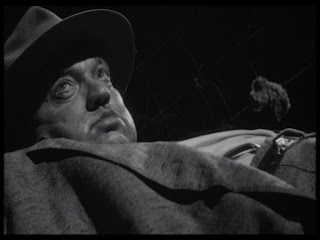
Commentaries on Touch of Evil, even the overwhelmingly positive ones, find it obligatory to include a snide remark on Charlton Heston's unsuitability for the role. I had no such qualms. Having seen fewer Heston films than I'd like to admit, and so being unacquainted with his all-American image, I found him quite believable as the Mexican Mike Vargas, his unflinching moral determination often leading him to abandon his damsel-in-distress wife when she most needs him. Orson Welles, his already-wide girth complemented by large amounts of padding and low-angle cinematography, is a genuinely menacing antagonist, especially when one considers a distant past when Quinlan must have been an honest detective. The Police Captain's long-time partner and good friend, Pete Menzies (Joseph Calleia) grovels admiringly at the feet of his superior, a somewhat pathetic devotee – forced to risk everything for the sake of his duty to the law – who ultimately lends an air of dignity to the parade of dark characters.

Charlton Heston wasn't far off the mark when he described Touch of Evil as "the greatest B-movie ever made." The film does, indeed, descend into subject matter of such squalor and revulsion that it seems the work of a filmmaker outside the polished Hollywood studio system. Nevertheless, the film is also the work of a consummate professional, with outstanding camera-work that often employs smoothly-shot long-takes. It's this contrast that I find most interesting about the film: Welles is utilising stylish and classy artistry to capture an environment completely devoid of style or class, a retched and depraved community of low-lives and petty criminals, drugs and sex, murder and corruption. This raw pulpiness, momentarily realised in the open minutes of Aldrich's Kiss Me Deadly (1955), is here brought to its apex. Welles' film, though completely overlooked at the 1959 Academy Awards, has since developed the status of a classic, and is perhaps his most celebrated film after his extraordinary 1941 debut, Citizen Kane. It was also the last film that the director would complete in Hollywood.
8/10

Currently my #2 film of 1958:
1) Vertigo (Alfred Hitchcock)
2) Touch of Evil (Orson Welles)
3) The Fountain of Youth (Orson Welles) (TV)

What others have said:

"Much of Welles' work was autobiographical, and the characters he chose to play (Kane, Macbeth, Othello) were giants destroyed by hubris. Now consider Quinlan, who nurses old hurts and tries to orchestrate this scenario like a director, assigning dialogue and roles. There is a sense in which Quinlan wants final cut in the plot of this movie, and doesn't get it. He's running down after years of indulgence and self-abuse, and his ego leads him into trouble. Is there a resonance between the Welles character here and the man he became?... To some degree, his characters reflected his feelings about himself and his prospects, and Touch of Evil may be as much about Orson Welles as Hank Quinlan. Welles brought great style to his movies, embracing excess in his life and work as the price (and reward) of his freedom."

"I first saw it when I was 14 and thought it was one of the worst pictures ever--garish, oppressive, and appallingly overacted. Grown up, I'd go with those same adjectives, except now I think it's one of the best. But I'm not going to recant my first response. Part of recognizing that Touch of Evil is a masterpiece means also recognizing that it's often suffocatingly unpleasant, and that Welles is working off his aggression for the vast, trash-movie audience that he hoped to attract. His compositions are teeming, unbalanced, with a center of gravity that lurches left then right."

"Touch of Evil smacks of brilliance but ultimately flounders in it. Taken scene by scene, there is much to be said for this filmization of Whit Masterson's novel, "Badge of Evil." Orson Welles' script contains some hard-hitting dialog; his use of low key lighting is effective, and Russell Metty's photography is fluid and impressive; and Henry Mancini's music is poignant. But Touch of Evil proves it takes more than good scenes to make a good picture... Off his rocker since his wife was murdered years ago, Welles supposedly is deserving of a bit of sympathy. At least, there's a hint of it in dialog, even though it isn't seen in his characterization. Aside from this, he turns in a unique and absorbing performance. Heston keeps his plight the point of major importance, combining a dynamic quality with a touch of Latin personality. Leigh, sexy as all get-out, switches from charm to fright with facility in a capable portrayal."
Variety, 1958
Also recommended from director Orson Welles:

"Macbeth (1948), the first of several Shakespeare adaptations from Orson Welles, is bleak, incredibly bleak. Shot on a restricted budget over just 21 days, the film spends most of its running time swathed in low-lying fog, evoking the haunting desolation and claustrophobia of the unknown Scottish wilderness. In terms of atmosphere, the film is completely brilliant, with Welles having transformed his meagre finances into an asset through his use of constrained sets and mist-obscured surroundings. The director himself, long valued for his incredible on screen presence, bellows his old-style dialogue at the audience, his delivery communicating an inescapable inner torment that leaves you drained and exhausted by the film's end."

"Many early television shows have a tendency to be horrendously stagnant and monotonous, with actors exchanging unconvincing lines amid a shoddy-looking production set with cardboard walls. However, for The Fountain of Youth (1958), Welles borrows from his extensive film-making experience to produce a work that is both refreshing and enjoyable. The eccentric editing techniques – cutting sporadically between still frames, live action and Welles' enigmatic narration – are similar to his later work in F for Fake (1974), and help make the story almost compulsively watchable."

"Vienna (1968) is a completely inconsequential addition to the great director's filmography, a mildly-contemplative reflection on a city of which the filmmaker was fond. That is not to say that I'm not glad to have watched it; after all, inconsequential Orson is better than no Orson at all... Employing a style of montage that effectively foreshadows that beguiling cinematic essay that is F for Fake (1974), Welles' ramble through Vienna can best be described as an affectionate home movie, a diary through which the director can translate a few of his thoughts on the world. His most interesting assertion comes at the beginning of the film, when Welles muses that the Vienna everybody remembers is a version of the city that never existed."

Read More...

Friday, August 15, 2008

Target #229: The Shop Around the Corner (1940, Ernst Lubitsch)

TSPDT placing: #238
Directed by: Ernst Lubitsch
Written by: Miklós László (play), Samson Raphaelson (screenplay), Ben Hecht (uncredited)


The Shop Around the Corner (1940) is a pleasant romantic comedy, not the sort that I will hold dear to me until the end of my days, but nonetheless a film thoroughly deserving of its reputation. By 1940, director Ernst Lubitsch had long ago taken Hollywood by storm, and his famed "Lubitsch touch" had become a sparkling commercial trademark. This film was planned for a 1939 release, but scheduling conflicts meant that James Stewart and Margaret Sullavan were unavailable for filming. Rather than substituting either of his main stars, Lubitsch decided to postpone production, in the meantime directing Greta Garbo in Ninotchka (1939). When it was finally completed, The Shop Around the Corner appears to have been met with relative indifference, receiving zero Oscar nominations despite an excellent screenplay by Samson Raphaelson and fine performances from its two leads and Frank Morgan in a supporting role. Time, nevertheless, has betrayed the film's massive and enduring influence, with high-profile remakes including In the Good Old Summertime (1949) and You've Got Mail (1998).
At its surface, one might assume The Shop Around the Corner to simply be the story of two lovers, Klara Novak (Sullavan) and Alfred Kralik (Stewart), who love each other without knowing it. However, Lubitsch's film runs much deeper than that. It's the story of Matuschek and Company, a stylish gift shop in Budapest, and the various human relationships that make the store such a close-knit family. When store-owner Hugo Matuschek (Frank Morgan) begins to suspect his oldest employee of having an affair with his wife, we witness the breakup of two families. There's absolutely no reason why the story should not have been set in the United States – perhaps in the blustery streets of New York – but Lubitsch was deliberately recreating the passions and memories of his former years in Europe, the quaintness of love and life before war brought terror and bloodshed to the doorstep. This subtle subtext brings a more meaningful, personal touch to the film – in fact, even as I write this review, I'm beginning to appreciate the story even more.

Sullavan and Stewart are both lovely in their respective roles, but I think that it's the supporting cast that really make the film. Each character brings a distinctive personality to the mix, and their interactions are always believable and enjoyable. I especially liked how Lubitsch knowingly directed much of our sympathy towards Hugo Matuschek, who, in any other film, would have been restricted to an underdeveloped, two-dimensional portrayal. Matuschek may have lost the love of his family, but he recaptures it in the affection of his employees, and you experience a heartwarming glow when, in the bitter cold of a Christmas Eve snowstorm, he finds companionship in the freckle-faced young errand-boy (Charles Smith). This genuine warmth towards a supporting character strikes me as being similar to several of Billy Wilder's later creations, for example, Boom Boom Jackson in The Fortune Cookie (1966) or Carlo Carlucci in Avanti! (1972). Of course, it doesn't really need saying, but Billy Wilder learned from the best.
7/10

Currently my #7 film of 1940:
1) The Great Dictator (Charles Chaplin)
2) The Grapes Of Wrath (John Ford)
3) Rebecca (Alfred Hitchcock)
4) Fantasia (James Algar et al.)
5) Pinocchio (Hamilton Luske, Ben Sharpsteen)
6) Foreign Correspondent (Alfred Hitchcock)
7) The Shop Around the Corner (Ernst Lubitsch)
8) His Girl Friday (Howard Hawks)
9) The Philadelphia Story (George Cukor)

What others have said:

"Who but Ernst Lubitsch could have pulled off such a winning romantic-comedy classic that dares to include, but is not marred by, such tragic undercurrents, with a frank subplot involving adultery, attempted suicide, and the collapse of a marriage? ... With consummate deftness, Lubitsch scratches the surface of ordinary characters and circumstances and reveals the reality behind the deceptive appearances — the substance and doubts beneath the vain posturing, the false heart behind the smiling face, the poetic soul behind the prosaic demeanor — and serves all of it up with soufflé-like lightness."

"When I watch a romantic comedy, I’ve come to expect certain things – a formulaic plot (usually some variation of the boy meets girl, boy loses girl, boy gets girl back in some wild situation), one-dimensional supporting characters, and over-sentimentality. Ernst Lubitsch is one of the few directors able to make a romantic comedy and avoid all of the genre’s negative aspects. The Shop Around the Corner is charming without being manipulative, fun without being repetitive, and witty without being pretentious."
Derek Smith, Apollo Guide

"Teaming Stewart, Sullavan and Morgan, just as in Borzage's The Mortal Storm (made the same year), this also deals with troubled romance in Central Europe, though here the threat is not Nazism but pride and the interference of others... It's a marvellously delicate romantic comedy, finally very moving, with the twisted intrigues among the staff also carrying narrative weight, Morgan's cuckolded proprietor being especially affecting. Thoroughly different from To Be or Not To Be but just as exhilarating, it's one of the few films truly justifying Lubitsch's reputation for a 'touch'."
Geoff Andrew, Time Out

Read More...

Thursday, August 7, 2008

Target #228: Our Hospitality (1923, John G. Blystone, Buster Keaton)

TSPDT placing: #359

Written by: Clyde Bruckman (story), Jean C. Havez (writer), Joseph A. Mitchell (writer)

After Three Ages (1923) proved that he could direct a feature-length comedy {he had merely starred in The Saphead (1920)}, Buster Keaton followed up its success with Our Hospitality (1923), a film that set the mould for the type of films that he would continue to produce for the remainder of his time at United Artists. Keaton plays the polite and well-meaning dolt, incredibly naive to a point, but, when roused into action, he has all the determination, daring and agility of a circus performer. Natalie Talmadge, as the pretty and delicate Virginia Canfield, provides the necessary romantic subplot, just enough to please, without saturating the story's more exciting elements. The overwhelmingly-quirky comedy is rarely laugh-out-loud hilarious, but there's a certain quaintness and modesty to the material that really works, communicated most noticeably through Keaton's characteristically-underplayed slapstick performance. Silent comedians often compensated for the absence of sound by grossly exaggerating every expression and gesture; Keaton, on the other hand, reacts to each new obstacle with the solemnity of a monk, his inconceivable deadpan passiveness somehow amplifying the humour.

It probably wouldn't be unreasonable to assume that Our Hospitality was originally conceived to accommodate Keaton's passion for locomotives, and he was able to indulge in the construction of a working Stephenson's Rocket – an early steam train with a 0-2-2 wheel arrangement. This petite locomotive provides some of the film's most memorable comedic moments, most of the enjoyment derived from low-key, episodic sight gags, whether it be Buster trying to wear his top hat in the cramped carriage, the dog that is continually in pursuit, the back wheels that roll loose, the donkey blocking the tracks, or the tracks themselves, which determinedly follow the contours of the earth with precarious rigidity. Though this train scarcely travels at a walking pace, some of the techniques that Keaton developed here would come in handy four years later, when he filmed his Civil War train epic, The General (1927). The remainder of the film is a sharp comedy-of-manners, as the wealthy Canfield family plots to murder Keaton's Willie McKay, the culmination of a generations-long feud between the two warring lineages.
Production took place from a screenplay by Clyde Bruckman, Jean C. Havez and Joseph A. Mitchell, and the writers aim a few good-natured digs at the American South. The family feud, which is continued throughout the decades despite the fact that nobody remembers how it began, sounds too ludicrous to be true, but I was surprised to learn of a firm grounding in fact – the story was, indeed, based on the bloody real-life feud between the Hatfield and McCoy families. Paradoxically, the film also celebrates the indomitable "Southern hospitality" of the local folk, and the Canfield family (led by Keaton-regular Joe Roberts, in his final role) grudgingly agrees to only shoot their hapless enemy once he has left the cover of their home and so has ceased to be their guest. As one might expect, Buster Keaton risked his neck on more than a few occasions, the most unforgettable stunt involving his dangling precariously from a log perched at the crest of a waterfall, and his daring acrobatic rescue of the beautiful damsel-in-distress. Talmadge may have been replaced by a dummy, but Keaton was there, as always, in the flesh.
8/10

Currently my #3 film of 1923:
1) A Woman of Paris: A Drama of Fate (Charles Chaplin)
2) Safety Last! (Fred C. Newmeyer, Sam Taylor)
3) Our Hospitality (Buster Keaton, John G. Blystone)
4) The Pilgrim (Charles Chaplin)
5) Why Worry? (Fred C. Newmeyer, Sam Taylor)

What others have said:

"Keaton was a stickler for historical accuracy, even well before his classic Civil War period piece, The General. Here the train is modeled after the earliest DeWitt Clinton steam engine that had movable track and was extremely slow, shown visually here with the dog that follows the train all the way. Passengers are jostled, and faces are blackened along the way--humorous exaggerated touches, but representative of early passenger train travel in the 1830s. Additionally, take note of the costumes; Keaton insisted on making them representative of the times. The rural setting of New York City isn't merely inserted for its humorous qualities--Keaton points out that the city scene is based on an actual photograph."

"Buster Keaton’s first feature-length comedy is one of his best, a comic gem set against a backdrop of a Hatfield-McCoy style family feud. Raised far from the scene of generations of “McKay-Canfield” violence, young Willie McKay (Keaton) knows nothing about the bad blood between the two families — until the time comes for him to go home and claim his inheritance... Fans of Keaton’s great train classic The General will be struck by Keaton’s early, adroit use of a much earlier period steam engine. This model runs on flexible tracks that look as if they were simply unspooled across the landscape, and the engine itself moves no faster than a horse-drawn buggy, allowing Willie’s dog to trot along under the cars for the duration of the trip."
Steven D. GreydanusAlso recommended from Buster Keaton:

"Buster Keaton's The Navigator, as a film, doesn't feel quite as complete as many of his other works, but it remains an enjoyable hour-long string of amusing gags with an abundance of Keaton's trademark deadpan humour. The idea for the film emerged when Keaton heard of the imminent scrapping of the SS Buford, a former army troop transport ship turned passenger liner. Seizing the opportunity, the comedy star purchased the ship cheaply and built an original story around this mammoth film prop."

"The second half of Steamboat Bill, Jr. (1928) is a completely different story. When a destructive cyclone bears down upon the small riverside town, all hell breaks loose, and Keaton finds himself wondering precariously through a crumbling labyrinth of abandoned streets and buildings. As he endeavours to rescue his father, who is locked up in the local jail, Keaton endures the savagery of the hurricane winds and flying debris, frequently dodging tumbling building walls. The storm is probably the most ambitious extended silent comedy sequence since Harold Lloyd scaled the skyscraper in Safety Last! (1923), and it is remarkable how, in the absence of any elaborate special effects, it all seems so believable."

"Buster Keaton catapults himself down a steep hillside, an avalanche of pebbles, rocks and boulders tumbling in his wake. If any one of these objects were to strike him down, he would certainly be killed by the impact. He is almost escaping the rocks now; just a few more seconds of frantic sprinting is required. Suddenly, Keaton looks up, only to find a massive horde of woman striding purposefully towards him. He is stuck between a rock and a hard place: an avalanche behind him, and a flock of would-be brides ahead. Quickly and delicately weighing his chances of survival either way, Keaton turns determinedly towards the barrage of boulders. It is hilarious little moments like this that make Buster Keaton's silent comedies such a joy to watch, and Seven Chances (1925) is certainly one of the funniest I've seen, brimming with the talented actor's trademark deadpan humour."

Read More...

Saturday, August 2, 2008

Repeat Viewing: Rope (1948, Alfred Hitchcock)

TSPDT placing: #955

Directed by: Alfred Hitchcock
Written by: Patrick Hamilton (play), Hume Cronyn (adaptation), Arthur Laurents (screenplay), Ben Hecht (uncredited)
Starring: James Stewart, John Dall, Farley Granger, Cedric Hardwicke, Constance Collier, Douglas Dick, Edith Evanson, Dick Hogan, Joan Chandler
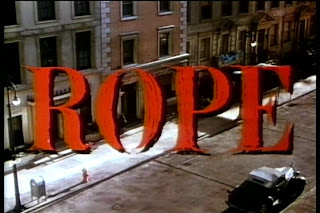
Alfred Hitchcock, despite his commercial popularity, was perhaps one of cinema's most audacious technical innovators. Even very early in his career – Blackmail (1929) was the first British film to make the cross-over into "talkies" – the Master of Suspense was forever searching for distinctive new means of telling a story and furthering his craft. Hitchcock was particularly interested in film-making that unfolded almost exclusively in a single restricted location, perhaps because of its likeness to a traditional stage play, or, more tellingly, because it allowed him to place the audience "in the room" with his nefarious characters. The director's first such endeavour was the radical Lifeboat (1944), which took place entirely on a small boat in the middle of the Atlantic, and similar "one-room" thrillers include Dial M for Murder (1954) and Rear Window (1954). Of course, the most experimental of these experiments was undoubtedly Rope (1948), a tense and intimate suspense tale that utilised extraordinarily-long takes to unfold the story almost in real-time. Against all odds, it's one of Hitchcock's finest.

Rope was adapted from Patrick Hamilton's 1929 stage play of the same name, itself inspired by the true-life story of Nathan Leopold and Richard Loeb, two wealthy University of Chicago students whose desire to commit the "perfect crime" culminated in murder in 1924. The film opens with the strangling murder of David Kentley (Dick Hogan) by two friends, Brandon Shaw (John Dall) and Phillip Morgan (Farley Granger), who have come to consider murder an art-form, a privilege bestowed only upon a select few superior individuals. In order to crown their masterpiece, and flaunt their superiority before colleagues, the pair have organised a dinner party in their apartment – attended by David's friends and family – the buffet served over their victim's lifeless body in an unlocked chest. As Brandon narcissistically drops vague hints as to David's fate, and Phillip descends into a restless drunken binge, former prep-school housemaster Rupert Cadell (James Stewart) senses that his students have been up to something, and that his own teachings on the philosophy of the Übermensch (Nietzsche's "Superman") may have been responsible.


All this action unfolds through ten continuous long takes, of between four and ten minutes in length, with around half of the transitions made "invisible" by dollying forward into the darkness of a character's back. As the characters move back and forth across Hitchcock's set, their lines and movements precisely choreographed, the cameramen and sound recordists track smoothly with them, constantly moving props and furniture out of the path of the filming equipment. This was the first occasion that such an audacious film-making technique had been trialled, and Rope wouldn't be bettered until digital technology allowed Aleksandr Sokurov to film the entirety of Russian Ark (2002) in a single take. Some have subsequently termed Hitchcock's film to be nothing but a gimmick, but to do so would be grossly unfair to all involved – indeed, when I first viewed the film, such was my immersion in the story that, unbelievably enough, it took me the bulk of the running time to even notice that I was watching unbroken takes.

Rope deliberately carries the air of a stage play, though the addition of a camera necessarily amplifies the intimacy of every situation. By eliminating almost all editing from his film, Hitchcock suspends the artificiality that is inherent in the art form – effectively flouting the wisdom of Eisenstein and Vertov – and allows the actions of his characters to tell the story. Characteristically, this technique also adds an element of voyeurism to our viewing the film, the unbroken takes suggesting that we, the audience, are actually standing in the room observing the proceedings. As the third perpetrator in the murder, we watch through anxious eyes as Brandon Shaw smugly offers dangerous insinuations, Phillip Morgan shakes uncontrollably at every item that might give away his crime, and Rupert Cadell thoughtfully begins to put the pieces together, despite his disbelief that such a cold-blooded murder could have been committed. Exhausting, exhilarating and, above all, entertaining, Alfred Hitchcock's Rope finds the Master of Suspense at the top of his game, a shining example of experimentation turned into great art.
9/10

Currently my #3 film of 1948:
1) The Treasure of the Sierra Madre (John Huston)
2) Ladri di biciclette {The Bicycle Thief} (Vittorio De Sicae)
3) Rope (Alfred Hitchcock)
4) Oliver Twist (David Lean)
5) Macbeth (Orson Welles)

What others have said:

"The novelty of the picture is not in the drama itself, it being a plainly deliberate and rather thin exercise in suspense, but merely in the method which Mr. Hitchcock has used to stretch the intended tension for the length of the little stunt. And, with due regard for his daring (and for that of Transatlantic Films), one must bluntly observe that the method is neither effective nor does it appear that it could be. For apart from the tedium of waiting or someone to open that chest and discover the hidden body which the hosts have tucked away for the sake of a thrill, the unpunctuated flow of image becomes quite monotonous. And the effort of application to a story of meager range becomes intense. The physical limitation of the camera to one approach compels it to stay as an eavesdropper on lots of dialogue and lots of business that are dull. And the yarn, by the nature of its writing, is largely actionless."

"To Hitchcock's credit, Rope never feels much like a stage play despite the lack of edits and its apartment set. It's too alive for that. It's a movie through and through. The director dresses it up in every possible way he can: the sound design is particularly smart, splitting the party into separate conversational layers. There's a great sequence with only one actor, the hired help, walking to and from the foreground cleaning off the living room chest cum coffin as the murderers and the guests continue their conversations. The amount of tension Hitchcock manages to build by doing so little is admirable. He also makes elegant use of music. Another great moment occurs in a conversation between James Stewart and one of the killers, with the canny use of a metronome to add to the time bomb effect of the deadly evening."

"Given Hitchcock's sensitivity to the anxieties upon which order is unnaturally erected, however, it is just as valid to see the murder as not so much a perversion of their mentor's teachings as a perversion of the feelings they are not allowed to express for each other. Hitchcock dutifully restores normalcy by sending estranged lovebirds Joan Chandler and Douglas Dick home at the end of the party, but his real interest lies with the society-whelped "monsters" and the smug teacher who comes to realize his own inescapable role in their condition. It's fitting that Hitchcock's themes of death and sex culminate in a pistol's climatic ejaculation out the window, a moment of necessary exposure that, leaving the three characters alone with their sobering revelations under the camera's non-dodging gaze, feels paradoxically liberating."

Read More...

Monday, July 28, 2008

Target #227: Laura (1944, Otto Preminger)

TSPDT placing: #320
Directed by: Otto Preminger, Rouben Mamoulian (uncredited)


WARNING: Plot and/or ending details may follow!!! [Paragraph 3 Only]

Laura. She's the talk of the town. She's enterprising, intelligent and beautiful. Men fall over themselves to get close to her, women envy her sophistication; Laura is, to paraphrase a very well-known detective, the stuff that dreams are made of. Such are her charms that she will even drive one respectable person to commit murder. Her murder. But who would want to kill Laura Hunt? Otto Preminger's nifty little 1940s thriller, Laura (1944), simultaneously evokes the spirit of hard-boiled pulp noir, an Agatha Christie murder mystery and even a little surreal fantasy. With a brief running time and an intimately-small cast, the film is perhaps closer in spirit to a traditional "countryhouse murder" tale than sprawling gangster film noir pictures like John Huston's The Maltese Falcon (1941) or Howard Hawks' The Big Sleep (1946). Nevertheless, stylistically, Laura is pure noir, and cinematographer Joseph LaShelle, a notable favourite of Billy Wilder later in his career, expertly employs shadows and lighting to create the close, claustrophobic atmosphere that arises when one person in the room must be a cold-blooded murderer.
There is no other way to say it: Gene Tierney is absolutely ravishing. From the film's opening moments, when we glimpse her seductive figure in a hanging portrait, my heart melted; I was instantly brought under her enchanting spell. If I may adopt the vocabulary of our hard-boiled hero, she's a perfect dame! When hard-edged cop Mark McPherson (Dana Andrews, the spitting image of Steve Martin in Dead Men Don't Wear Plaid (1982)) is assigned to investigate the brutal murder of the city's most coveted women (Tierney), he uncovers a bizarre romantic triangle that offers endless motives for such a heinous crime. Waldo Lydecker (Clifton Webb), an older newspaper columnist with a reputation for acid wit, originally offered Laura her big break in business, and had protectively maintained a relationship with her that surpassed love and bordered on obsession. Meanwhile, a wealthy charmer, Shelby Carpenter (Vincent Price), had asked for Laura's hand in marriage, a proposal about which she had been non-committal. Even in death, Laura's femme fatale charm remains just as potent, and Lt. McPherson soon finds himself infatuated with her lingering spirit.

Then, of course, comes the wonderfully-surreal moment when our love-struck detective awakens to watch his murder victim walk into the room. Originally, Rouben Mamoulian {Dr. Jekyll and Mr. Hyde (1931)} had been hired to direct the film, and his version ended with the revelation that Laura's reappearance had merely been a dream, a construction of McPherson's subconscious. When producer Otto Preminger decided to take over, he unceremoniously scrapped Mamoulian's completed footage and started over. Even without this final psychological complication, which might nevertheless have seemed a cop-out, Preminger's mystery is consistently engrossing and often fascinating. Most intriguing of all is Lydecker's relationship with Laura, and Clifton Webb's unconventional yet highly-effective casting in the role. The noted Broadway performer had not acted in a film since the silent era, but his flamboyant and foppish personality translates perfectly to the screen. Lydecker doesn't seem to actually love Laura, but rather he wishes to be her, to live vicariously through her, and for any man (other than himself) to be in Laura's life is an affront both to himself and his sexuality.
8/10

Currently my #4 film of 1944:
1) Double Indemnity (Billy Wilder)
2) Arsenic and Old Lace (Frank Capra)
3) Gaslight (George Cukor)
4) Laura (Otto Preminger)
5) Lifeboat (Alfred Hitchcock)

What others have said:

"Not just another noir classic of '44, Laura almost succeeds in pulling the screen apart at the seams, if only to stitch it together again in a visibly frantic finale. The narrator's a critic, the cop a would-be necrophiliac, and the femme fatale a faceless corpse... or are they? Less investigative thriller than an investigation of that genre's conventions - voyeurism (looking at, and for, Laura), a search for solutions (not just whodunit but whodunwhat), and the race against time (clues and clocks, fantasies and flashbacks) - the plot is deliberately perfunctory, the people deliciously perverse, and the mise-en-scène radical."

"Otto Preminger's directorial debut (1944), not counting the five previous B films he refused to acknowledge and an earlier feature made in Austria. It reveals a coldly objective temperament and a masterful narrative sense, which combine to turn this standard 40s melodrama into something as haunting as its famous theme. Less a crime film than a study in levels of obsession, Laura is one of those classic works that leave their subject matter behind and live on the strength of their seductive style."

"Waldo Lydecker, who introduces himself to a detective investigating the murder of the titular Laura by stepping out of a bath like some hybrid of Smithers and Mr. Burns, acts as the piece's unreliable narrator, stalking through his scenes like a dandy in honorary high collar and spats while providing the strangest contention in a strange film: that this aging, fey, homosexual lothario was passionately in love with his ward, Laura. The picture might be the most overt iteration of film noir as a genre about emasculation ever put to celluloid, and trying to puzzle out whether Waldo's for real and chief gumshoe McPherson buys any of his honeyed hooey constitutes a good portion of what's fun and maddening in equal measure about it. That tension between what's ridiculous and what the characters take seriously makes Laura a mystery, for sure, but not for the obvious reasons."

Read More...

Friday, July 25, 2008

Target #226: Andrey Rublyov / Andrei Rublev (1969, Andrei Tarkovsky)

TSPDT placing: #48


Just as Andrei Rublev faced doubt about whether or not, having sinned, he could continue his celebrated iconography, I likewise find myself in two minds about Andrei Tarkovsky's film. My experience with the director's other work is, as usual, limited, but I still couldn't shake that persistent expectation that I would love Andrei Rublev (1969). There is certainly much to love about it, but my appreciation for the film can best be described as admiration rather than affection, and, though I can speak with only the utmost praise for Tarkovsky's achievement, it doesn't occupy that exclusive space close to my heart. The film is a deeply-personal religious work, an examination of faith and moral values, and so perhaps it's inevitable that the film didn't leave such a deep impression, considering my preference towards atheism; one unfortunately cannot discard all personal convictions for the mere purposes of appreciating a work of art. I do, however, like to think that the majesty of cinema, in most cases, is able to transcend religious boundaries.

Andrei Tarkovsky released his first feature-length film, Ivan's Childhood, in 1962. Even prior to its release, the director had already expressed interest in filming the life of great Russian iconographer Andrei Rublev, even though very little is actually known about his life. Working with a screenplay written by himself and Andrei Konchalovsky, Tarkvosky began filming in 1964, and a 205-minute cut was screened for a private audience in Moscow in 1966. The critical response, however, was mixed, and sizeable cuts were made to the film's running time, before a 186-minute version screened out of competition at the Cannes Film Festival in 1969. I'm not entirely sure which version I ended up watching; the time counter indicated somewhere around 165 minutes, though my brief research couldn't uncover any major missing sequences. In hindsight, I should probably have held out for longer and acquired the Criterion Collection DVD, which restores the picture to its four-hour glory. In several years' time, when I inevitably decide to revisit Tarkovsky's film, I'll make certain to do just that.


Andrei Rublev is divided into nine distinct segments, including a colour epilogue displaying Rublev's weathered icons as they exist today. They each explore a facet of the great painter's life, placing particular emphasis on his faith in God and how it relates to his work on frescos and icons. Interestingly, though Rublev (Anatoli Solonitsyn) himself appears in most of the stories, he is often hidden in the background, a passive observer on the behaviour of others, including Kirill (Ivan Lapikov), who is jealous of Rublev's recognition, and young Boriska (Nikolai Burlyayev), who successfully casts a bell using faith rather than knowledge. One consequence of this narrative format is a lack of cohesiveness in Tarkovsky's storytelling. We adequately follow the plot of each segment, but, as the whole, the film doesn't seem to build towards any notable climactic revelation – the completed film is equal to the sum of its parts, which is still very impressive, but pulls it short of being a masterpiece. Once again, however, I must acknowledge that the 205-minute version may potentially correct this problem.

One statement that can not be disputed, however, is that Andrei Rublev really is a beautiful piece of film-making. Vadim Yusov's black-and-white photography captures the exquisite delicateness of nature with almost heartbreaking intricacy; even the raindrops of a midday shower are imbued with the gentle elegance of the Heaven from which they ostensibly fell. Tarkovsky finds simple beauty in the quiver of a tree branch in the breeze, the leisurely flow of a river, herds of livestock fleeing from an aerial balloon. In portraying the complete opposite, the destruction of nature, the director is capable but not quite the master he is otherwise. The raiding of Vladimir by a troop of Tatars was obviously supposed to be the centrepiece of the picture, but Tarkovsky underplays every detail to such an extent that his "chaos" ultimately winds down into a staged conflict. Compare this sequence with Sergei Bondarchuk's burning of Moscow in War and Peace (1967), in which one feels as though he has descended into the fires of Hell, and the contrast is telling.
8/10

Currently my #2 film of 1969:
1) Midnight Cowboy (John Schlesinger)
2) Andrey Rublyov {Andrei Rublev} (Andrei Tarkovsky)
3) Take the Money and Run (Woody Allen)

What others have said:

"The key is that the events in the film illuminate Rublev's state of mind -- or rather they show what Tarkovsky imagines to be Rublev's state of mind, since few facts are known about the painter's actual life story. In that way, Rublev's character here is emblematic of The Artist, particularly one torn between a devotion to the spiritual and the nagging sensation that, perhaps, there is a great hypocrisy behind much of what masquerades as spirituality."

"Lacking the cult credentials of Tarkovsky's later and more immediate sci-fi films Solaris and Stalker, Andrei Rublev delivers something more austere; a story of oblique mysticism that styles the artist as a Christ-like figure crucified by the brutality of the age as he wanders in search of redemption and - what may perhaps be ultimately the same thing - inspiration. Rublev becomes Tarkovsky's own canvas, and it is on him that the filmmaker paints a vision of his belief in art as a means of rediscovering the spiritual."

"Based on the life of fifteenth century Russian monk and icon painter Andrei Rublev (Anatoli Solonitzine), this magnificently mounted epic film follows his experiences in a Russia ravaged by Tartar invaders. Rublev is shown during various times of his life--the period is vividly recreated in all its violence. The movie represents that very rare hybrid, an epic that is highly personal, expressing the feeling of an artist who is in inherent and endemic conflict with the surrounding society and its oppressive institutions."

Read More...