Orson Welles was undoubtedly one of the finest filmmakers of the twentieth century, and yet the entire span of his career carried with it an air of tragedy. Knowing exactly what he wanted in his films, Welles frequently stood on the toes of studio executives, usually unsuccessfully, and most of his pictures were eventually cut and re-cut into completely different entities. By the end of his career, studios were refusing to fund any of his films, numerous projects were abandoned and Welles' lingering cinematic genius went to waste. With the exception of The Magnificent Ambersons (1942), Touch of Evil (1958) is the director's most famous butchered masterpiece. Furious with the alterations that had been made to his work, Welles wrote a 58-page memo highlighting the changes he would like to see made. It was not until 1998 that a "director's cut" based upon Welles' wishes was edited and released, and this is the version that I have just enjoyed, considered definitive by most Wellsians. Additionally, I was lucky enough to experience the film in the cinema, in a classic double-bill with Carol Reed's The Third Man (1949).
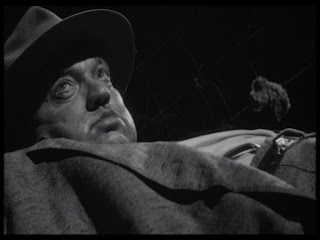
Welcome to Los Robles, a small town on the border of Mexico and the United States. As by-the-book Mexican narcotics cop Mike Vargas (Charlton Heston) explains, "all border towns bring out the worst in a country." Drugs, alcohol and firearms do a steady trade; greed and corruption stretches to the very heights of law enforcement. Police Captain Hank Quinlan (Orson Welles) is the most respected American detective in the region, but he is as corrupt as the criminals whom he puts behind bars daily. Unshaven, obese, obsessed and arrogant, Quinlan boasts no redeeming qualities, a stupid and dangerous hunk of flesh. He is truly a formidable villain, and perhaps one of the finest that I have seen in a film: he's Harry Lime without the likable boyish charisma. However, and herein lies the dilemma, Quinlan is one helluva good detective, and his procedures, however dubious, often get the job done. But is it acceptable to convict even a guilty criminal based on fabricated evidence, or does this make Quinlan the worst criminal of all?


After a home-made bomb tears apart the vehicle of a wealthy American businessman (via an astonishing uninterrupted three-minute crane tracking shot), Detective Vargas offers his aid in solving the crime. He is currently on a honeymoon with his newly-married American wife, Susie (Janet Leigh), but his job appears to be a priority to him, and he is often neglectful of the women he loves. Few are enthusiastic about having a Mexican's help in the case, and Vargas' involvement will later lead Quinlan to cross the line between dishonesty and pure evil. Filmed as a B-movie on a B-movie budget (Welles was paid meager $125,000 for his writing, acting and directorial duties, only to have his film butchered by the producers),
Touch of Evil exploits its low-budget roots for maximum shock value, inviting the audience into a highly-exaggerated, unrelentingly-sinister web of deceit, lies, betrayal and murder. Almost every supporting character – from the bulging Quinlan to the sleazy, slimy Mexican drug-lords of the Grandi family – have not a redeeming value to their characters.


Commentaries on Touch of Evil, even the overwhelmingly positive ones, find it obligatory to include a snide remark on Charlton Heston's unsuitability for the role. I had no such qualms. Having seen fewer Heston films than I'd like to admit, and so being unacquainted with his all-American image, I found him quite believable as the Mexican Mike Vargas, his unflinching moral determination often leading him to abandon his damsel-in-distress wife when she most needs him. Orson Welles, his already-wide girth complemented by large amounts of padding and low-angle cinematography, is a genuinely menacing antagonist, especially when one considers a distant past when Quinlan must have been an honest detective. The Police Captain's long-time partner and good friend, Pete Menzies (Joseph Calleia) grovels admiringly at the feet of his superior, a somewhat pathetic devotee – forced to risk everything for the sake of his duty to the law – who ultimately lends an air of dignity to the parade of dark characters.
Charlton Heston wasn't far off the mark when he described
Touch of Evil as "the greatest B-movie ever made." The film does, indeed, descend into subject matter of such squalor and revulsion that it seems the work of a filmmaker outside the polished Hollywood studio system. Nevertheless, the film is also the work of a consummate professional, with outstanding camera-work that often employs smoothly-shot long-takes. It's this contrast that I find most interesting about the film: Welles is utilising stylish and classy artistry to capture an environment completely devoid of style or class, a retched and depraved community of low-lives and petty criminals, drugs and sex, murder and corruption. This raw pulpiness, momentarily realised in the open minutes of Aldrich's
Kiss Me Deadly (1955), is here brought to its apex. Welles' film, though completely overlooked at the 1959 Academy Awards, has since developed the status of a classic, and is perhaps his most celebrated film after his extraordinary 1941 debut,
Citizen Kane. It was also the last film that the director would complete in Hollywood.
8/10
Currently my #2 film of 1958:
1) Vertigo (Alfred Hitchcock)
2) Touch of Evil (Orson Welles)
3) The Fountain of Youth (Orson Welles) (TV)
What others have said:
"Much of Welles' work was autobiographical, and the characters he chose to play (Kane, Macbeth, Othello) were giants destroyed by hubris. Now consider Quinlan, who nurses old hurts and tries to orchestrate this scenario like a director, assigning dialogue and roles. There is a sense in which Quinlan wants final cut in the plot of this movie, and doesn't get it. He's running down after years of indulgence and self-abuse, and his ego leads him into trouble. Is there a resonance between the Welles character here and the man he became?... To some degree, his characters reflected his feelings about himself and his prospects, and Touch of Evil may be as much about Orson Welles as Hank Quinlan. Welles brought great style to his movies, embracing excess in his life and work as the price (and reward) of his freedom."
"I first saw it when I was 14 and thought it was one of the worst pictures ever--garish, oppressive, and appallingly overacted. Grown up, I'd go with those same adjectives, except now I think it's one of the best. But I'm not going to recant my first response. Part of recognizing that Touch of Evil is a masterpiece means also recognizing that it's often suffocatingly unpleasant, and that Welles is working off his aggression for the vast, trash-movie audience that he hoped to attract. His compositions are teeming, unbalanced, with a center of gravity that lurches left then right."
"Touch of Evil smacks of brilliance but ultimately flounders in it. Taken scene by scene, there is much to be said for this filmization of Whit Masterson's novel, "Badge of Evil." Orson Welles' script contains some hard-hitting dialog; his use of low key lighting is effective, and Russell Metty's photography is fluid and impressive; and Henry Mancini's music is poignant. But Touch of Evil proves it takes more than good scenes to make a good picture... Off his rocker since his wife was murdered years ago, Welles supposedly is deserving of a bit of sympathy. At least, there's a hint of it in dialog, even though it isn't seen in his characterization. Aside from this, he turns in a unique and absorbing performance. Heston keeps his plight the point of major importance, combining a dynamic quality with a touch of Latin personality. Leigh, sexy as all get-out, switches from charm to fright with facility in a capable portrayal."
 Also recommended from director Orson Welles:
"Macbeth (1948), the first of several Shakespeare adaptations from Orson Welles, is bleak, incredibly bleak. Shot on a restricted budget over just 21 days, the film spends most of its running time swathed in low-lying fog, evoking the haunting desolation and claustrophobia of the unknown Scottish wilderness. In terms of atmosphere, the film is completely brilliant, with Welles having transformed his meagre finances into an asset through his use of constrained sets and mist-obscured surroundings. The director himself, long valued for his incredible on screen presence, bellows his old-style dialogue at the audience, his delivery communicating an inescapable inner torment that leaves you drained and exhausted by the film's end."
"Many early television shows have a tendency to be horrendously stagnant and monotonous, with actors exchanging unconvincing lines amid a shoddy-looking production set with cardboard walls. However, for The Fountain of Youth (1958), Welles borrows from his extensive film-making experience to produce a work that is both refreshing and enjoyable. The eccentric editing techniques – cutting sporadically between still frames, live action and Welles' enigmatic narration – are similar to his later work in F for Fake (1974)
, and help make the story almost compulsively watchable."
"Vienna (1968) is a completely inconsequential addition to the great director's filmography, a mildly-contemplative reflection on a city of which the filmmaker was fond. That is not to say that I'm not glad to have watched it; after all, inconsequential Orson is better than no Orson at all... Employing a style of montage that effectively foreshadows that beguiling cinematic essay that is F for Fake (1974)
, Welles' ramble through Vienna can best be described as an affectionate home movie, a diary through which the director can translate a few of his thoughts on the world. His most interesting assertion comes at the beginning of the film, when Welles muses that the Vienna everybody remembers is a version of the city that never existed."
 Then there's the cast, of course. Jennifer Jones plays Pearl Chavez, a half-breed Injun who is invited to live on a respected Texas ranch after her father (Herbert Marshall) murders his unfaithful wife and her lover. Pearl's ethnicity is shamelessly exploited to perpetuate the stereotype that Native Americans inherently possess some sort of uncontrollable base sexuality; Pearl spends most of the film fighting to keep her clothes on, and she is instinctively drawn to Lewt (Gregory Peck), a downright bastard with almost adolescent sexual urges. Joseph Cotten plays the selfless McCanles brother, and Lillian Gish and Lionel Barrymore (probably the only Hollywood actor to carry on a prolific career from a wheelchair) are excellent as the owners of the ranch. The cast is rounded off nicely by Charles Bickford as a genial rancher, and Walter Huston, who hilariously overplays his role as a preacher ("The Sinkiller") and steals every scene. Indeed, most of the performers overplay their roles, perhaps recognising that the story (adapted from a novel by Niven Busch) would not work if played entirely straight.
 What I found most interesting about Duel in the Sun is how, even as early as 1946, it subverted the traditional notions of honour and nobility that formed the backbone of the Western genre. Joseph Cotten's character remains the film's only decent male, and yet he is dismissed mid-way through the film, and must settle on marrying a woman who is far less sensuous and desirable than Pearl Chavez. The film's climax involves two lascivious lovers scrambling through the dirt to each other's arms, only seconds after mortally wounding each other with bullets (inspiring the film's derisive nickname "Lust in the Dust"). Their attraction is purely physical – Pearl is disgusted by Lewt's moral decadence, and yet is inexplicably drawn to his embrace, even after sealing his demise. If the film's intention was to present Pearl's struggle for acceptance into "honourable" white society, then she nevertheless ends the film as she started, stranded between conflicting instincts and emotions that she can't control. Her bid for nobility has failed. Perhaps this is the birth of the Revisionist Western.


 Into the rubble-strewn ruins of Vienna comes an American pulp-novelist, Holly Martins (Joseph Cotten), who arrives, without a dime in his pocket, in search of an old friend named Harry Lime. However, upon his arrival, Martins is horrified to to learn of Lime's tragic death in a traffic accident. Unsatsified with the explanations he receives from the authorities and witnesses, he teams up with Lime's ex-girlfriend Anna Schmidt (Aldi Valli) to solve the mystery of his best friend's death. Was it an accident? Was it murder? Who was the "third man" who was seen carrying Lime to the roadside? Of course, as you and I both know, Martins' childhood friend, having faked his own death, is very much alive, and intent on keeping his continued existence quiet. The extraordinary moment, when Harry Lime's face is abruptly illuminated in a doorway, as a cat affectionately nuzzles his shoes, hardly comes as a surprise after fifty years, but the magic is very much still there.
 Orson Welles' amused boyish smirk, wryly taunting Martins across the roadway, signals the entrance of one of cinema's most charismatic supporting characters. Despite being absent for the first half of the film, Lime's presence is felt throughout, his darkened shadow continually towering over Martins as he seeks to ascertain the actual cause of his friend's death. Lime is a perfect example of cinema's anti-hero, a vibrant, likable and identifiable personality who commits atrocities that should immediately warrant our detestation. Graham Greene's brisk and intelligent screenplay gives Lime all the best lines, particularly on the Ferris Wheel ride when he muses on the value of those inconsequential "little dots" walking below, though Welles himself takes credit for penning the celebrated "cuckoo clock" monologue; a rapidly-delivered acknowledgment of the creativity born from "warfare, terror, murder, and bloodshed." Though Welles justifiably receives a lot of the praise, every other cast member delivers a wonderful performance, particularly Cotten as the bemused and morally-conflicted foreigner, Valli as Lime's steadfast lifelong disciple, and Trevor Howard as the Major who very much wishes that Lime had remained underground.
 Director Carol Reed famously clashed with producer David O. Selznick over various facets of the film's production, with Selznick insisting on pivotal casting decisions, and allegedly suggesting that the film be titled "Night Time in Vienna." However, in the case of the suitably downbeat ending, both producer and director saw eye-to-eye, and Greene's original optimistic conclusion (in which Holly and Anna reconcile) was shelved in favour of the wonderful static long-shot, in which Martins is completely ignored by the women whose trust he is perceived to have broken. The Third Man, perhaps as a result of these contradictory artistic influences, has acquired, like no other film I've seen, a distinct personality of its own. Karas' zither soundtrack, as though consciously flouting traditional noir conventions, adds an element of whimsy to the proceedings, and somehow complements perfectly the larger-than-life distortion of Krasker's photography, in which ordinary human shadows tower three storeys in height, and even the most commonplace of interactions takes on the warped dimensions of a drug-induced dream. In Vienna, the truth can be as elusive as a ghost.
 The first forty minutes of The Lady from Shanghai left me relatively indifferent, in the sense that I had no idea where the story was heading, and couldn't understand the significance of the film's events to date. My reaction, apparently, differs little from that of Columbia Pictures President Harry Cohn, who couldn't decipher Welles' labyrinthian tale, and demanded that somebody explain it to him. The story itself was lifted from Sherwood King's novel, "If I Die Before I Wake," which was chosen practically at random. Welles had offered to adapt the book when Cohn gave him an urgently-needed $55,000 to finance costuming for his musical stage-show, "Around the World in Eighty Days." Filming for the film took place, in addition to the Columbia Pictures studios, in San Francisco and Acapulco, Mexico, aboard a yacht belonging to none other than Errol Flynn. Welles' original cut for the film ran 155 minutes, but, as occurred with tragic regularity through his career, the studio raised their scissors to his picture, slicing off at least an hour of footage.
 It is perhaps because of this studio interference that The Lady from Shanghai cuts rather choppily from a thriller to a courtroom drama. The trial episode is played largely for satire, with Welles emphasising the blatant disorder of the courtroom, abound with constant interruptions from noisy audience members and sneezing jurors {one cut juxtaposes the judge playing chess with an aerial shot of the courtroom, suggesting that it's all just a perverted game}. Welles' inventive use of the camera is always a treat to observe; in one sequence, as Michael (Welles) speaks with George (Glenn Anders) atop an ocean lookout, the downwards-angled camera dangles the two characters over a fatal precipice. The film's climax is absolutely unforgettable, a gripping and innovative shoot-out in a carnival house of mirrors. As each character blasts away at illusory images of their enemies, the bullets shatter their own reflected profiles, fulfilling Michael's foreshadowing anecdote that compares Elsa (Hayworth) and Arthur (Everett Sloane) to sharks gnawing feverishly at their own flesh.


_poster.jpg)


