TSPDT placing: #85
Directed by: John Ford
Written by: Dorothy M. Johnson (short story), James Warner Bellah (screenplay), Willis Goldbeck (screenplay)
Starring: John Wayne, James Stewart, Vera Miles, Lee Marvin, Edmond O'Brien, Andy Devine, John Carradine, Jeanette Nolan, John Qualen, Woody Strode, Strother Martin, Lee Van Cleef
 WARNING: Plot and/or ending details may follow!!! [Paragraphs 3 + 4 Only]
A Western like The Man Who Shot Liberty Valance (1962) could only have been produced by a man reaching the twilight of his career. Suddenly, all those gunfights, bar brawls and romantic quarrels, to be found in abundance in John Ford's previous efforts, don't seem quite so exciting anymore, and all we're left with is the lingering melancholy of nostalgia, the memory of wasted years and missed opportunities. Many critics say that Ford reached full maturity with The Searchers (1956), the powerful tale of a cowboy plagued with guilt and racial prejudice. However, even that film required a lighthearted romantic subplot to break up the drama, a typical Ford inclusion that rather thinned the emotional intensity of the primary narrative. Liberty Valance offends similarly – Edmond O'Brien's drunkenness and Andy Devine's cowardice are clearly played for laughs – but this does little to detract from the story at the film's heart, a wistful reminiscence of the Old West, before it became civilised, and the untruths that helped build the core of the Western legend.
John Wayne and James Stewart were, of course, no strangers to the Western genre. Their casting, aside from adding commercial appeal to the picture, was made with a very deliberate intention in mind – after years of defining these two actors' Western identities, Ford would then systematically break them down, to reveal the bitter truths about life, love and death in the Old West. But, in a way, Ford seems to prefer the "uncivilised" and "lawless" lands prior to the arrival of the educated man – we watch with disdain as a fast-talking politician (John Carradine) carelessly spouts lies to add dramatic effect to his speech, and refers to Liberty Valance (Lee Marvin) as "the bullet-ridden body of an honest citizen." Just how did the scholarly law-man, who arrives in town without a gun, manage to conquer the West, to defeat the likes of Liberty Valance? The truth is that he could only have done it with the aid of true men like Tom Doniphon (Wayne), who compromised their values and later lived to regret it.


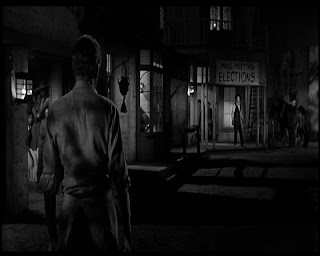
The Man Who Shot Liberty Valance comes at the cross-roads of a radical transformation in the Western genre. That same year, young director Sam Peckinpah released Ride the High Country (1962), a key landmark in the development of the Revisionist Western, a subgenre that critiqued the idealistic themes of the traditional Western, and favoured realism of romanticism. Ford's film is wholly traditional in terms of film-making style, with the majority of filming taking place on studio sets rather than on location. This decision, a departure from the director's other famous Westerns (which often made excellent use of Monument Valley, Arizona) was made to stress the film's greater emphasis on characters. At the same time, however, Liberty Valance is a reflection on the fallacy of Ford's Old West, a mournful footnote to decades of the director's work. Here, the villain isn't killed in a fair fight, but he's gunned down from the shadows; the hero doesn't win the girl, but dies lonely. In fact, I'm not even sure there are heroes in this story. Only legends.
This is, without a doubt, one of Ford's saddest Westerns; rather than looking towards the future with hope, its characters are instead looking back with wistful regret. The West, which was once a wilderness, has been transformed into a garden, and a well-meaning politician has built a career upon an act that he can't claim to be his own. Wayne's Tom Doniphon perhaps comes closer to heroism than any other character, but he shot his foe, unseen, from a side-street, and thus his reward is not the respect and admiration of a nation, nor the love of the girl (Vera Miles) whom he adores. Instead, the courageous but foolish educated man, Ransom Stoddard (Stewart) reaped the benefits of his "achievement," and his life is forever tinged with the guilt of his own success. We can almost see Stoddard's conscience tearing itself apart when the railway conductor good-naturedly quips, "nothing's too good for the man who shot Liberty Valance." Perhaps Stoddard did shoot Liberty Valance. The legends tell us that this is the case, and so now the truth, whatever it may be, doesn't make an ounce of difference.
9/10
Currently my #6 film of 1962:
1) Lawrence of Arabia (David Lean)
2) La Jetée {The Pier} (Chris Marker)
3) Le Procès {The Trial} (Orson Welles)
4) To Kill A Mockingbird (Robert Mulligan)
5) Birdman of Alcatraz (John Frankenheimer)
6) The Man Who Shot Liberty Valance (John Ford)
7) Cape Fear (J. Lee Thompson)
8) The Manchurian Candidate (John Frankenheimer)
9) Dr. No (Terence Young)
10) Ride the High Country (Sam Peckinpah)
2) La Jetée {The Pier} (Chris Marker)
3) Le Procès {The Trial} (Orson Welles)
4) To Kill A Mockingbird (Robert Mulligan)
5) Birdman of Alcatraz (John Frankenheimer)
6) The Man Who Shot Liberty Valance (John Ford)
7) Cape Fear (J. Lee Thompson)
8) The Manchurian Candidate (John Frankenheimer)
9) Dr. No (Terence Young)
10) Ride the High Country (Sam Peckinpah)
 What others have said:
"The contrast between charismatic and legal authority in John Ford's The Man Who Shot Liberty Valance is even more interesting, because it parallels the difference between the values of the West or Wilderness (John Wayne) and the values of the East or Civilization (James Stewart). Stewart's Ranse Stoddard embodies rational-legal authority, symbolically as well as practically. A decent lawyer from the East, he comes to practice law and bring order to the West. Wayne, by contrast, is the uneducated leader who believes that "You make your own justice here and enforce your law." He is the rugged individual, using physical force, not laws, in fighting Liberty Valance, an outlaw, because it is the only efficient way."
"The Man Who Shot Liberty Valance is a drama that shreds the fabric of legend, as well as man's need to cling to simplified, inspirational stories that separate good from evil. The film examines how the truth of history is always obscured by hearsay, assumptions and outright deception, and observes how legends rise from the ashes of grit and pain.... The crux of the film involves Stoddard's own showdown with Valance, and a secret surrounding the specifics of what exactly went down. Doniphon shows true heroism by putting aside his own interests for the common good. Of course, the purpose of the movie is to explain that ideas and spirit mean a whole lot more than facts. Ideas and symbols are more powerful than bullets."
Phil Villarreal, 2006
"But I can't get all misty eyed over Ford's legendary take on the Old West and his attempt to show that the greatness of the country came from those heroic roots, as he dismisses in importance whether all the stories are true or not and how short memories are for Americans. The way Ford sees it Stewart had the vision what America should be like, but if it wasn't for Wayne's gun that vision would never have happened. I found this history lesson less than genuine and far too simplistic and chilling, even though the film had some value as entertainment fodder."
Dennis Schwartz, 2003
 Also recommended from director John Ford:
* Drums Along the Mohawk (1939)
"When production of Drums Along the Mohawk began to run behind schedule and over-budget, producer Darryl F. Zanuck, knowing that a great battle had yet to be filmed, became understandably anxious.... Ford decided to abandon the entire sequence; placing Fonda in front of the camera, he gently put forth a succession of questions concerning the conflict, and the actor improvised from there... In a deliberate, deadpan tone of voice, Fonda recounts the horrors of skirmish; the horror of comrades falling beside him; the terrifying war-cry of the enemy; the appalling waste of life. This was the slice of Ford genius for which I had been waiting."
"When production of Drums Along the Mohawk began to run behind schedule and over-budget, producer Darryl F. Zanuck, knowing that a great battle had yet to be filmed, became understandably anxious.... Ford decided to abandon the entire sequence; placing Fonda in front of the camera, he gently put forth a succession of questions concerning the conflict, and the actor improvised from there... In a deliberate, deadpan tone of voice, Fonda recounts the horrors of skirmish; the horror of comrades falling beside him; the terrifying war-cry of the enemy; the appalling waste of life. This was the slice of Ford genius for which I had been waiting."
* The Fugitive (1947)
"Unlike many of the Westerns that brought director John Ford his greatest fame, The Fugitive is entirely unconcerned with any form of action or dialogue; Ford's film-making is so concentrated on establishing the correct emotional atmosphere for each scene that it occasionally strays into tedium. However, it was obviously a very personal project for the Ford – who once called it "perfect" – and it's difficult to criticise a film into which the director poured so much passion and resolve.... A visual masterpiece this film may be, and certainly an overall interesting watch, but The Fugitive remains inferior Ford."
"Unlike many of the Westerns that brought director John Ford his greatest fame, The Fugitive is entirely unconcerned with any form of action or dialogue; Ford's film-making is so concentrated on establishing the correct emotional atmosphere for each scene that it occasionally strays into tedium. However, it was obviously a very personal project for the Ford – who once called it "perfect" – and it's difficult to criticise a film into which the director poured so much passion and resolve.... A visual masterpiece this film may be, and certainly an overall interesting watch, but The Fugitive remains inferior Ford."
"Prior to this film, I'd always seen Henry Fonda as a decent and honourable everyman, so it was interesting to see him depart from his usual upright persona. Conceited and stubborn, Lt. Colonel Thursday is a tragic pillar of eroded military integrity, his once-impressive leadership abilities now overshadowed by an unyielding desire for immortality; the young men whose lives he sacrificed in order to imprint himself in history's pages will never be remembered by name, but, as Capt. York muses at the film's conclusion, their spirit will forever live on in the plight of their successors."


 Following the defeat of General Custer at the Battle of Little Bighorn, the American frontier is in disarray. Tribes of Native Americans – Cheyenne, Comanche, Apache – are forgetting their petty inter-tribal disputes and banding together in opposition to the invading settlers. Capt. Nathan Cutting Brittles, though somewhat reluctant to retire at such as crucial stage of the conflict, embarks on his final objective, though is hampered by the baggage of two women (Joanne Dru, Mildred Natwick) who must be evacuated before winter sets in. The film's storyline is somewhat inconsequential, never threatening to even approach the emotional depth of 'The Searchers,' and some of the film's events are almost incomprehensible to one who is ill-versed in American history and Westerns in general. However, Wayne's profound characterisation of Capt. Brittles forms the picture's core, and he is, indeed, astonishing in the subtle and thoughtful complexity that he brings to his character. The remaining, less-experienced players, such as Harry Carey Jr. and John Agar, aren't particularly memorable, but serve the story adequately and with presumably-sound authenticity.
  Fortunately, John Ford litters the rather lightweight story with an enjoyable amount of humour, compensating for the relative lack of emotional depth with sheer entertainment. Sgt. Quincannon (Victor McLaglen) provides most of the laughs, particularly during a drunken brawl sequence that sees him fending off seven able-bodied soldiers and still finding time to take another sip of whisky between swings. Also mildly amusing is the friction between lieutenants Flint Cohill and Ross Penell (Agar and Carey, Jr.), both of whom notice that Olivia Dandridge (Joanne Dru) is wearing a yellow ribbon, and hope that it is for them. The story's ending struck me as something of an anti-climax, even though, admittedly, it would have been downright arrogant for Ford to alter history. As the Native Americans congregate in preparation for a direct assault on their enemies, Brittles' stern conversation with Chief Pony That Walks (Chief John Big Tree) promises an incredible climactic battle of epic proportions. However, when John Wayne astutely manages to disrupt the planned attack by scattering the tribes’ horses, I couldn’t help feeling just a bit disappointed.
-1.jpg) Intertwined within this darkly-themed tale of obsession and prejudice is a somewhat awkwardly-placed romance between Martin and Laurie Jorgensen (Vera Miles), one that belongs in a lesser Western to this one. The selection of eccentric supporting characters, including those played by Ward Bond, Hank Worden and Ken Curtis, certainly provide some amusement for the audience, but ultimately detract from the murky themes that comprise the heart of the story, of Ethan’s endless search to retrieve his niece from the Comanches; or, otherwise, to purge her “pollution” through murder. As far as Weste
Intertwined within this darkly-themed tale of obsession and prejudice is a somewhat awkwardly-placed romance between Martin and Laurie Jorgensen (Vera Miles), one that belongs in a lesser Western to this one. The selection of eccentric supporting characters, including those played by Ward Bond, Hank Worden and Ken Curtis, certainly provide some amusement for the audience, but ultimately detract from the murky themes that comprise the heart of the story, of Ethan’s endless search to retrieve his niece from the Comanches; or, otherwise, to purge her “pollution” through murder. As far as Weste


_poster.jpg)


