TSPDT placing: #133
Directed by: Woody Allen
Written by: Woody Allen, Marshall Brickman
Starring: Woody Allen, Diane Keaton, Tony Roberts, Carol Kane, Paul Simon, Shelley Duvall, Christopher Walken
Alvy Singer (Woody Allen) is something of a hopeless romantic. A cynical, death-obsessed New York Jewish comedian, Singer has never been able to maintain a steady relationship with a woman. He has been married twice, and divorced twice. He broke up with one woman because of their disagreements over the "second shooter" conspiracy of John F. Kennedy's assassination, or perhaps that was just his excuse. To paraphrase Freud, possibly Groucho Marx, he simply "would never want to belong to any club that would accept someone like him for a member." He doesn't drive because he is paranoid about driving; he has been seeing a psychiatrist for the past fifteen years, though these appointments were long ago reduced to simple "whining" sessions. There is an inherent uncertainty in everything that Singer says – as though he really knows what he's talking about, but he can't convince himself that he's got it right.
When he accompanies a friend (Tony Roberts) to a tennis game, Singer's first and foremost concern is that the club will deny him entry because he's a Jew. However, that fateful game serves forth something so much more significant and life-changing – he comes to meet the ditsy and exuberant Annie Hall (Diane Keaton). Despite clearly having very little in common, something clicks between the two eligibles, and they embark on a tumultuous years-long relationship that will inevitably fail to materialise into anything further. Erupting with clever dialogue and witty cultural references, Annie Hall's script is one of the best you'll ever see. Not only is the conversation entertaining to listen to, but – even with all the talking to the camera and interacting with random extras – it actually manages to seem startlingly realistic. This is no small thanks, of course, to the main actors, who embody their characters so perfectly that we're unsure if they are acting or merely playing themselves.

Though he had previously released a few well-received, light-hearted affairs, it was Annie Hall that blasted writer/actor/director Woody Allen into the realms of super-stardom. In an uncharacteristic move for the Academy, Allen's film won four 1978 Oscars, including Best Actress (Keaton), Best Original Screenplay (Allen, Marshall Brickman), Best Director (Allen) and Best Picture – not undeservedly, though millions of Star Wars fans would, I'm sure, disagree. Having revisited Annie Hall for the first time in a year, having since enjoyed many of Allen's other films, I am genuinely amazed at his transition from silly comedian to insightful observer on human relationships. Of course, a noticeable evolution in his film-making style is evident in both the science-fiction Sleeper (1973) and the Russian historical spoof Love and Death (1975), but neither boasts the the intelligence nor the sophistication of this film, which wholly discards the Chaplin-like slapstick of Allen's previous films and adopts the Tracy-Hepburn screwball comedy of a decade later.
Originally slated – and filmed, in fact – as a New York murder mystery with a romantic sub-plot, Annie Hall was taken by editor Ralph Rosenbaum and cut down (massacred, if you will) into the modern, witty 1970s screwball comedy that we still enjoy today. It is truly amazing that such an extensive post-production reshaping had no obvious ill effects upon the general flow of the film, though the structure in itself is so hectic that we probably wouldn't notice it, anyway: Allen frequently cuts forwards and backwards in time, his modern characters are able to revisit and discuss the past, characters in split screens interact, Allen regularly breaks the "fourth wall" and addresses the audience directly. Some of the discarded murder mystery elements from Annie Hall were later incorporated into another Allen film, Manhattan Murder Mystery (1993), which also co-starred Keaton.

 Aside from Allen and Keaton, numerous smaller roles provide a crucial framework for the overall structure of the film. Tony Roberts is Rob, Singer's old friend and confidant. Paul Simon (of Simon and Garfunkel) plays a record producer who takes a keen interest in both Annie and her singing. Shelley Duvall is a reporter for 'The Rolling Stone' magazine, and a one-time girlfriend of Singer. There are also tiny early roles for Christopher Walken (as Annie's somewhat disturbed brother), Jeff Goldblum (who speaks one memorable line at a party – "Hello? I forgot my mantra") and Sigourney Weaver (who can be briefly glimpsed as Singer's date outside a theatre). Two slightly more unusual cameos come from Truman Capote (as a Truman Capote-lookalike, no less) and scholar Marshall McLuhan (whom Singer suddenly procures from behind a movie poster to declare to a talkative film-goer that "you know nothing of my work!").
Easily the most innovative and energetic of the films I've so far seen from Woody Allen, Annie Hall is a spirited glimpse at the incompatibility of human beings, and a cynical yet bittersweet meditation on the falsity of the perfect romantic Hollywood ending. It is also a considerable comedic achievement, and Allen would repeatedly recycle his trademark neurotic New Yorker screen persona, most notably in Manhattan (1979), but never with more success than this premium outing in excellence. The engagingly-convoluted storyline moves with such briskness that you don't realise just how very little happens, and that, by the film's end, our characters are exactly where they were at the beginning. Nevertheless, Allen manages to say something significant about human relationships – they're totally irrational, crazy and absurd, but we keep attempting them because of what they give us in return. Or, at least, what we think they give us.
9/10
Currently my #2 film of 1977:
1) Star Wars (George Lucas)
2) Annie Hall (Woody Allen)
3) Close Encounters of the Third Kind (Steven Spielberg)

 Love and Death (1975) was obviously produced shortly after an Ingmar Bergman marathon, and the film is both an affectionate homage and an enjoyable spoof of The Seventh Seal (1957), Bergman's memorable meditation on the nature of religion and death. The perfect bittersweet ending sees Death, cloaked in a white sheet, leading our hero in a Danse Macabre across the countryside. Also targeted by Allen's razor-sharp flair for parody are the epic Russian novels of Dostoyevsky and Tolstoy, such as "Crime and Punishment," "The Idiot" and "War and Peace." A singularly-absurd recreation of the Battle of Waterloo, which – among other anachronisms – is catered by a New York hot-dog vendor, is also an amusing send-up of Sergei Bondarchuk's impressive box-office disaster Waterloo (1970), and even Bonaparte himself makes a surprise appearance as both an assassination target, and to demand the completion of the pastry to be named in his honour {we call them vanilla slices down here in Australia}.
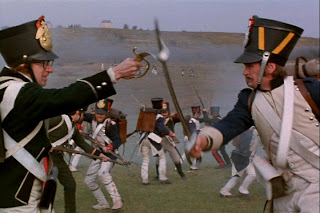 Woody Allen and Diane Keaton, in their third of many collaborations, work together perfectly as cousins (and later partners) who like to bicker endlessly about the meaning of life, their conversations descending swiftly into dubious pseudo-philosophical ramblings of which I was able to make neither head nor tail. With the exception of one bottle gag that wouldn't have been out of place in a Chaplin film, most of the humour is purely verbal, and Allen even experiments with breaking the fourth wall, a style of comedy that he would implement with astonishing success in Annie Hall. In terms of story, Love and Death, in spite of its episodic nature, comes together more completely than any of Allen's previous films, and the jokes are consistently funny enough to draw a laugh. Considerably funnier than that other famous historical comedy released in 1975 (if I may be so bold), this is one of Woody Allen's funniest movies, with more than enough intelligent humour to go around.


