TSPDT placing: #22
Directed by: Orson Welles
Written by: Whit Masterson (novel), Orson Welles (screenplay), Paul Monash, Franklin Coen (reshoots)
Starring: Charlton Heston, Janet Leigh, Orson Welles, Joseph Calleia, Dennis Weaver, Marlene Dietrich
Orson Welles was undoubtedly one of the finest filmmakers of the twentieth century, and yet the entire span of his career carried with it an air of tragedy. Knowing exactly what he wanted in his films, Welles frequently stood on the toes of studio executives, usually unsuccessfully, and most of his pictures were eventually cut and re-cut into completely different entities. By the end of his career, studios were refusing to fund any of his films, numerous projects were abandoned and Welles' lingering cinematic genius went to waste. With the exception of The Magnificent Ambersons (1942), Touch of Evil (1958) is the director's most famous butchered masterpiece. Furious with the alterations that had been made to his work, Welles wrote a 58-page memo highlighting the changes he would like to see made. It was not until 1998 that a "director's cut" based upon Welles' wishes was edited and released, and this is the version that I have just enjoyed, considered definitive by most Wellsians. Additionally, I was lucky enough to experience the film in the cinema, in a classic double-bill with Carol Reed's The Third Man (1949).
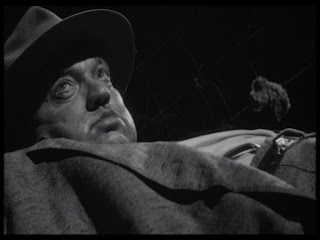
Welcome to Los Robles, a small town on the border of Mexico and the United States. As by-the-book Mexican narcotics cop Mike Vargas (Charlton Heston) explains, "all border towns bring out the worst in a country." Drugs, alcohol and firearms do a steady trade; greed and corruption stretches to the very heights of law enforcement. Police Captain Hank Quinlan (Orson Welles) is the most respected American detective in the region, but he is as corrupt as the criminals whom he puts behind bars daily. Unshaven, obese, obsessed and arrogant, Quinlan boasts no redeeming qualities, a stupid and dangerous hunk of flesh. He is truly a formidable villain, and perhaps one of the finest that I have seen in a film: he's Harry Lime without the likable boyish charisma. However, and herein lies the dilemma, Quinlan is one helluva good detective, and his procedures, however dubious, often get the job done. But is it acceptable to convict even a guilty criminal based on fabricated evidence, or does this make Quinlan the worst criminal of all?


After a home-made bomb tears apart the vehicle of a wealthy American businessman (via an astonishing uninterrupted three-minute crane tracking shot), Detective Vargas offers his aid in solving the crime. He is currently on a honeymoon with his newly-married American wife, Susie (Janet Leigh), but his job appears to be a priority to him, and he is often neglectful of the women he loves. Few are enthusiastic about having a Mexican's help in the case, and Vargas' involvement will later lead Quinlan to cross the line between dishonesty and pure evil. Filmed as a B-movie on a B-movie budget (Welles was paid meager $125,000 for his writing, acting and directorial duties, only to have his film butchered by the producers), Touch of Evil exploits its low-budget roots for maximum shock value, inviting the audience into a highly-exaggerated, unrelentingly-sinister web of deceit, lies, betrayal and murder. Almost every supporting character – from the bulging Quinlan to the sleazy, slimy Mexican drug-lords of the Grandi family – have not a redeeming value to their characters.


Commentaries on Touch of Evil, even the overwhelmingly positive ones, find it obligatory to include a snide remark on Charlton Heston's unsuitability for the role. I had no such qualms. Having seen fewer Heston films than I'd like to admit, and so being unacquainted with his all-American image, I found him quite believable as the Mexican Mike Vargas, his unflinching moral determination often leading him to abandon his damsel-in-distress wife when she most needs him. Orson Welles, his already-wide girth complemented by large amounts of padding and low-angle cinematography, is a genuinely menacing antagonist, especially when one considers a distant past when Quinlan must have been an honest detective. The Police Captain's long-time partner and good friend, Pete Menzies (Joseph Calleia) grovels admiringly at the feet of his superior, a somewhat pathetic devotee – forced to risk everything for the sake of his duty to the law – who ultimately lends an air of dignity to the parade of dark characters.
Charlton Heston wasn't far off the mark when he described Touch of Evil as "the greatest B-movie ever made." The film does, indeed, descend into subject matter of such squalor and revulsion that it seems the work of a filmmaker outside the polished Hollywood studio system. Nevertheless, the film is also the work of a consummate professional, with outstanding camera-work that often employs smoothly-shot long-takes. It's this contrast that I find most interesting about the film: Welles is utilising stylish and classy artistry to capture an environment completely devoid of style or class, a retched and depraved community of low-lives and petty criminals, drugs and sex, murder and corruption. This raw pulpiness, momentarily realised in the open minutes of Aldrich's Kiss Me Deadly (1955), is here brought to its apex. Welles' film, though completely overlooked at the 1959 Academy Awards, has since developed the status of a classic, and is perhaps his most celebrated film after his extraordinary 1941 debut, Citizen Kane. It was also the last film that the director would complete in Hollywood.
8/10
Currently my #2 film of 1958:
1) Vertigo (Alfred Hitchcock)
2) Touch of Evil (Orson Welles)
3) The Fountain of Youth (Orson Welles) (TV)

What others have said:
"Much of Welles' work was autobiographical, and the characters he chose to play (Kane, Macbeth, Othello) were giants destroyed by hubris. Now consider Quinlan, who nurses old hurts and tries to orchestrate this scenario like a director, assigning dialogue and roles. There is a sense in which Quinlan wants final cut in the plot of this movie, and doesn't get it. He's running down after years of indulgence and self-abuse, and his ego leads him into trouble. Is there a resonance between the Welles character here and the man he became?... To some degree, his characters reflected his feelings about himself and his prospects, and Touch of Evil may be as much about Orson Welles as Hank Quinlan. Welles brought great style to his movies, embracing excess in his life and work as the price (and reward) of his freedom."
Roger Ebert, 1998
"I first saw it when I was 14 and thought it was one of the worst pictures ever--garish, oppressive, and appallingly overacted. Grown up, I'd go with those same adjectives, except now I think it's one of the best. But I'm not going to recant my first response. Part of recognizing that Touch of Evil is a masterpiece means also recognizing that it's often suffocatingly unpleasant, and that Welles is working off his aggression for the vast, trash-movie audience that he hoped to attract. His compositions are teeming, unbalanced, with a center of gravity that lurches left then right."
David Edelstein, 1998
"Touch of Evil smacks of brilliance but ultimately flounders in it. Taken scene by scene, there is much to be said for this filmization of Whit Masterson's novel, "Badge of Evil." Orson Welles' script contains some hard-hitting dialog; his use of low key lighting is effective, and Russell Metty's photography is fluid and impressive; and Henry Mancini's music is poignant. But Touch of Evil proves it takes more than good scenes to make a good picture... Off his rocker since his wife was murdered years ago, Welles supposedly is deserving of a bit of sympathy. At least, there's a hint of it in dialog, even though it isn't seen in his characterization. Aside from this, he turns in a unique and absorbing performance. Heston keeps his plight the point of major importance, combining a dynamic quality with a touch of Latin personality. Leigh, sexy as all get-out, switches from charm to fright with facility in a capable portrayal."
Variety, 1958
 Also recommended from director Orson Welles:
"Macbeth (1948), the first of several Shakespeare adaptations from Orson Welles, is bleak, incredibly bleak. Shot on a restricted budget over just 21 days, the film spends most of its running time swathed in low-lying fog, evoking the haunting desolation and claustrophobia of the unknown Scottish wilderness. In terms of atmosphere, the film is completely brilliant, with Welles having transformed his meagre finances into an asset through his use of constrained sets and mist-obscured surroundings. The director himself, long valued for his incredible on screen presence, bellows his old-style dialogue at the audience, his delivery communicating an inescapable inner torment that leaves you drained and exhausted by the film's end."
"Many early television shows have a tendency to be horrendously stagnant and monotonous, with actors exchanging unconvincing lines amid a shoddy-looking production set with cardboard walls. However, for The Fountain of Youth (1958), Welles borrows from his extensive film-making experience to produce a work that is both refreshing and enjoyable. The eccentric editing techniques – cutting sporadically between still frames, live action and Welles' enigmatic narration – are similar to his later work in F for Fake (1974), and help make the story almost compulsively watchable."
"Vienna (1968) is a completely inconsequential addition to the great director's filmography, a mildly-contemplative reflection on a city of which the filmmaker was fond. That is not to say that I'm not glad to have watched it; after all, inconsequential Orson is better than no Orson at all... Employing a style of montage that effectively foreshadows that beguiling cinematic essay that is F for Fake (1974), Welles' ramble through Vienna can best be described as an affectionate home movie, a diary through which the director can translate a few of his thoughts on the world. His most interesting assertion comes at the beginning of the film, when Welles muses that the Vienna everybody remembers is a version of the city that never existed."


_poster.jpg)


