....Just last night, I was lucky enough to enjoy a double-bill of Alfred Hitchcock's classic thrillers Rear Window (1954) and Vertigo (1958) - the latter in 70mm - at the Astor Theatre in St. Kilda, Melbourne.
....Rear Window was the more crowd-friendly of the two films, with John Michael Hayes' darkly-humorous dialogue getting plenty of laughs throughout. The climactic sequence also got an unexpected laugh, when one overly-enthusiastic female audience member let out a scream as the villain came in for the kill. Even after all these years, the Master of Suspense still hasn't lost the power to thrill us!
 TSPDT placing: #41
Directed by: Alfred Hitchcock
Written by: Cornell Woolrich (short story), John Michael Hayes (screenplay)
Starring: James Stewart, Grace Kelly, Wendell Corey, Thelma Ritter, Raymond Burr, Judith Evelyn
WARNING: Plot and/or ending details may follow!!!
There can be absolutely no doubt that Alfred Hitchcock was one of the most gifted film directors ever to work in Hollywood, and Rear Window is one film that demonstrates most exhaustively his enormous talents. I must admit that, on my first viewing of the film, I was quite new to his work, and, whilst I thought it was a solid achievement, it didn't strike me as being anything particularly special. How wrong I was! With subsequent viewings of Rear Window, I was able to better appreciate its intricacies: the flawless performances, the 100 minutes of subtle, wonderfully-executed suspense, the shades of delightfully-dark humour, the manner in which Hitchcock places the viewer inside Jeff's tiny apartment. Released in 1954, Rear Window was the second of four Hitchcock films to star James Stewart (the others being Rope, Vertigo and The Man Who Knew Too Much), and the second of three to feature one of Hollywood's greatest beauties, Grace Kelly (Dial M for Murder, To Catch a Thief).
On the surface, the plot to Rear Window is deceptively straightforward. The screenplay was written by four-time Hitchcock collaborator John Michael Hayes, and based loosely on the short story "It Had to be Murder," by Cornell Woolrich. Confined to his apartment with a broken leg, successful adventure photographer L. B. "Jeff" Jefferies (Stewart) passes the tedious days and weeks by peering through the window at his neighbours, watching and learning their daily activities and rituals. When he is not being a voyeur, Jeff is distracted by visits from an embittered insurance company nurse, Stella (Thelma Ritter), and his beautiful, glamorous socialite girlfriend, Lisa (Kelly). Jeff's "peeping tom" activities have become considerably more serious than simply a means of passing the time, and he is soon immersed in the triumphs and failures of his neighbours. On one particular night, Jeff notices a man in the apartment across the courtyard (Raymond Burr) acting in a suspicious manner, and, despite the doubt of his friends, he begins to suspect that this man has committed an absolutely heinous crime.


The sheer genius of Rear Window is not just how well-executed this storyline is, but how Hitchcock ties it together with numerous other narratives, making all of the strings equally-interesting to watch. Each of the apartments visible from Jeff's window acts like a different world – a separate movie – and the combination of all of these creates a rich tapestry of lifestyles, and a range of human relationships that mirror that of Jeff and Lisa. For example, there is hard-working salesmen Lars Thorwald, who arrives home each day to the incessant nagging of his invalid wife (Irene Winston); the woman in the floor below, dubbed "Miss Lonelyheart" (Judith Evelyn), is a hopeless romantic who, in her depression, is addicted to alcohol and sleeping pills; a young music writer (Ross Bagdasarian) struggles to make an income; a sexy young dancer, "Miss Torso" (Georgine Darcy), practises her dance moves and battles various suitors; two newly-weds frequently culminate their marriage with the blinds drawn, though, by the end of the film, the wife has begun the nagging that is arguably characteristic of the gender!


Despite obviously being in love with Lisa, Jeff is apprehensive of approaching marriage, fearing that his gritty, adventurous, globe-trotting lifestyle will not be compatible with Lisa's love of socialising and high-fashion (she is never caught wearing the same expensive dress twice). At first, we notice Jeff using the lives of those in the other apartments to distract from the troubles in his own, and he often uses the examples before him to support the decisions that he must make in his own life. As the film progresses, Lisa reveals a daring, audacious streak in trying to solve the mystery, and Jeff realises that, when love is concerned, small compromises can and should be made in order to make a fateful relationship work. As the film closes, we notice Lisa lying on a bed in common, unglamorous clothing, reading the book, "Beyond the High Himalayas," no doubt in preparation for the couple's next adventure. However, though some compromises have been made, Lisa still remains her own women, suddenly casting aside Jeff's reading material and raising her own "Harper's Bazaar" magazine to her face.
Despite the multitude of little narratives that comprise the film, the most significant – and, indeed, the one we remember best – is that of Lars Thorwald and his missing wife, Anna. After witnessing the former acting suspiciously during a stormy night, Jeff suspects that the over-worked and under-appreciated Thorwald has brutally murdered his wife, decapitated her body into several pieces and carried out the remains in a suitcase. Though Jeff's police detective ex-War buddy, Thomas J, Doyle (Wendell Corey), believes Jeff's story to be fantastic, Stella and Lisa soon come to accept the theory as fact, helping an immobile Jeff to solve the mystery. That we never fully understand the motivations of the murderer, having to be content with brief glimpses from afar, is crucial to Hitchcock's storytelling, and, by making the audience complicit in his characters' voyeurism, we feel as though our safety is being placed in jeopardy. The entire film possesses a very subtle air of unrelenting suspense, but the final ten minutes or so are among the most thrilling in cinema history.
9/10
Currently my #1 film of 1954:
1) Rear Window (Alfred Hitchcock)
2) Dial M for Murder (Alfred Hitchcock)
3) Sabrina (Billy Wilder)
4) The Maggie (Alexander Mackendrick)
5) The Caine Mutiny (Edward Dmytryk)
 What others have said:
"Jimmy Stewart’s broken leg is a simple enough device – and metaphor – that glues him to the window overlooking other windows. He even questions his prying himself: but when he does, we find ourselves excusing him so we can keep watching with him.... All those characters we glimpse across from Jeff’s window are real people, given dimension by basic but brilliant filmmaking techniques. These are valid even today, when their distant actions may differ, but their characters would be much the same. So if you combine the observant, voyeuristic joys with the subtle, sliding grip of tension that Hitchock generates, you will be glued to the screen. It’s not the best position to be in, unless you love cinema. The point is, you can’t help yourself – and that’s Alfred’s point, too."
Andrew L. Urban, Urban Cinefile
"There's a mystery at the center of Alfred Hitchcock's Rear Window and it sure ain't whether the traveling salesman murdered his wife. That Macguffin merely sets us up to ponder the strange romance between Grace Kelly and Jimmy Stewart. Kelly's character is, at least to the audience, irresistible: a perfectly turned-out society girl, all goodness and style on the outside, all seething passions on the inside.... One of the most profound delights in Hitchcock's masterpiece is the witty, seductive performance Kelly fashions as she slyly campaigns to convince Stewart that, in all her perfection, she's just as "bad" as Miss Torso, the undulating dancer across the courtyard whom he finds so appealingly imperfect."
Joshua Mooney, Movieline
"Steeped in fetishism, concerned with l'amour fou, and structured by dream logic, Vertigo is Hollywood's surrealist masterpiece; Rear Window showcases another side of Hitchcock's vulgar modernism. It's a blatantly conceptual movie, self-reflexively concerned with voyeurism and movie history, the bridge from Soviet montage to Andy Warhol's vacant stare, as well as a construction founded on the 20th-century idea of the metropolis as spectacle—or, more specifically, on the peculiar mixture of isolation and overstimulation the big city affords. Reveling in the simultaneity of the 8 million stories in the Naked City, Rear Window is the slyly alienated precursor of multiple narratives like Short Cuts or Magnolia."
J. Hoberman, Village Voice, January 18, 2000

Also recommended from director Alfred Hitchcock:
"Rebecca (1940) isn't the sort of thriller that lulls you into a false sense of security and then shocks you, since that was simply not Hitchcock's style. Like another Gothic thriller of which I am fond, George Cukor's Gaslight (1944), the main character is forever at ill-ease with her surroundings, and we, as the audience, are never afforded the luxury of feeling safe and secure. Rebecca de Winter is one of the most meticulously-detailed unseen characters in the history of cinema, and, without the story ever straying into supernatural territory, it seems as though her lingering presence is somehow orchestrating the disturbing events of the film."
"Stage Fright (1950) certainly isn't one of Alfred Hitchcock's greatest films, but I like it – quite a lot, in fact... Hitchcock's whimsical sense of humour, evident in a great many of his pictures, is allowed to permeate the traditional drama/romance storyline, and the film would certainly have felt comfortable alongside the Ealing comedies of the late 1940s and early 1950s, many of which employed darkly comedic overtones. Both Rope (1948) and Under Capricorn (1949) had made pioneering use of long-takes, sweeping the camera across the room with astonishing style and grace. For the first time, Hitchcock and cinematographer Wilkie Cooper integrated these techniques into a more traditional film-making style."
"Despite Hitchcock later dismissing Spellbound (1945) as "just another manhunt story wrapped in pseudo-psychology," I'm willing to slide the film into the director's top ten, albeit in the latter section of the list. Rather than delivering the nail-biting suspense for which Hitchcock was best known, the film offers a lighthearted romance and adventure story, mixed with some memory-orientated mystery and intrigue. What happens when you fall in love with a man who might be a cold-blooded murderer? Even more tantalisingly, what if you yourself suffer amnesia and are faced with the very real possibility that you've killed a man?"

Read More...
Summary only...
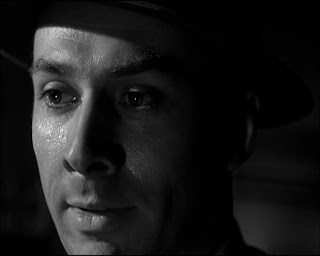 When just-out-of-prison pickpocket Skip McCoy (Richard Widmark) snags the purse of a woman on the subway (Jean Peters), he pockets more than he'd originally bargained for. The woman, Candy, and her cowardly ex-boyfriend Joey (Richard Kiley) had been smuggling top-secret information to the Communists, and McKoy has unexpectedly retrieved an important roll of micro-film. Will he turn in the MacGuffin to the proper authorities, or sell it to the highest bidder? If Pickup on South Street has a flaw, it's that the story seems designed solely to bolster an anti-Communist agenda, reeking of propaganda like nothing since WWII {Dwight Taylor, who supplied the story, also notably wrote The Thin Man Goes Home (1944), the only propagandistic movie of the series}. For no apparent reason, every identifiable character – even the smugly self-serving Skip McCoy – eventually becomes a self-sacrificing patriot, the transformation predictable from the outset. In traditional film noir, the unapologetic criminal always gets his comeuppance, the rational punishment for his sins, but apparently not when they've served their country; patriotism wipes the slate clean.
 Richard Widmark, an actor who I'm really beginning to like, plays the haughty pickpocket with composure, though always with that hint of ill-ease that suggests he's biting off more than he can chew. The opening scene on the train is the film's finest, as McCoy breathlessly fishes around in his victim's hand bag, recalling Bresson's Pickpocket (1959). Thelma Ritter is terrific as a tired street-woman who'll peddle information to anybody willing to pay for it (though, of course, she draws the line at Commies). Jean Peters is well-cast as the trashy dame passing information to the other side, playing the role almost completely devoid of glamour; Fuller reportedly cast the actress on the observation that she had the slightly bow-legged strut of a prostitute. Nevertheless, Peters must suffer a contrived love affair with Widmark that really brings down the film's attempts at realism. Fascinatingly, upon its release, Pickup on South Street was promptly condemned as Communist propaganda by the FBI, and the Communist Party condemned it for being the exact opposite. Go figure.
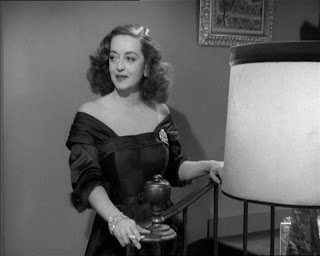 On the brightly-lit stages of Broadway, respected but aging theatre star Margo Channing (Bette Davis) clings extravagantly to roles for which she is far too old; as though Mankiewicz and Billy Wilder were exchanging ideas, you can almost see her turning into Norma Desmond a few years down the track. One night, Margot is introduced to ostensibly her biggest fan, a meek and sincere young woman named Eve Harrington (Anne Baxter) – now, remember that name! Had I known beforehand that Eve is considered one of American cinema's finest villains, the first half of the film would have severely confused me – what detestable qualities could possibly be exhibited by this shy, modest and frankly adorable admirer of theatre? I decided that the mutual looks of contempt with which Margo and Karen (Celeste Holm) greet Eve's theatre award (a less-prestigious version of the Oscars) were merely the result of unfounded jealousy, and their resentment that such a modest girl could have received the high honour. When the penny finally dropped, oh, how I felt like a fool!
 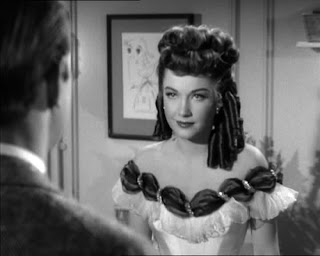 Bette Davis, late in her career, was one of the few actresses with enough sheer charisma to persevere in Hollywood despite her relative lack of glamour or traditional beauty. In All About Eve, her aging features look tired and almost grotesque – I say this not derisively, but as an observation for how well Davis suits her character. Margo Channing could never have been played by an actress still completely at ease with her looks. In comparison, Anne Baxter illuminates every room, particularly after her selfish intentions are revealed to the audience. The moment of revelation, when she stands, still in costume, positively pulsating with ambition, desire and lust, is a shocking betrayal that really took me aback. The film uniquely emphasises female dominance, with the inconsequential, malleable husbands (Hugh Marlowe and Gary Merrill) frequently relegated to the sidelines. However, George Sanders, as the sharp-tongued columnist Addison DeWitt, holds such contemptuous views towards society that he recognises Eve's game from the very beginning, watches it with amused, admiring eyes, before promptly reasserting his male superiority over her in the final scenes.
 What others have said:


_poster.jpg)


