TSPDT placing: #282
Directed by: Ernst Lubitsch
Written by: Melchior Lengyel (story), Charles Brackett (screenplay), Billy Wilder (screenplay), Walter Reisch (screenplay)
Starring: Greta Garbo, Melvyn Douglas, Ina Claire, Bela Lugosi, Sig Ruman, Felix Bressart, Alexander Granach
I find it a little odd that, on the cusp of WWII, Hollywood delivered a piece of anti-Communist propaganda, when clearly there were, at that time, more immediate threats to European freedom. Ninotchka (1939) was produced while Ernst Lubitsch waited for Margaret Sullavan and James Stewart to become available for The Shop Around the Corner (1940), but it was by no means merely a fill-in project: the film was Greta Garbo's first and only collaboration with Lubitsch, and the actress' penultimate role before a premature retirement. MGM's publicity campaign used the tagline "Garbo Laughs!" to advertise that this was a new type of role for the enigmatic actress, a comedy that promised to humanise her otherwise somber screen persona {this campaign deliberately referenced the tagline for Garbo's Anna Christie (1930), which had proclaimed "Garbo Talks!"}. Though the screenplay by Billy Wilder, Charles Brackett and Walter Reisch unsurprisingly has many genuine sparks of wit, the balance of romance, farce and political commentary never quite sits as comfortably as one would expect given the talents involved.
 When three Soviet diplomats (Sig Ruman, Felix Bressart and Alexander Granach) arrive in Paris to sell off some jewelry confiscated from the Grand Duchess (Ina Claire) during the Bolshevik Revolution, they find it difficult to keep their minds on their work. Far away from the cold, drab apartments of Moscow, the French capital is bustling with life, warmth and prosperity (just forget that the French upper-class are not, in fact, a reasonable yardstick for comparison with the Soviet proletariat). Playful aristocrat Léon (Melvyn Douglas), the Duchess' romantic lover, succeeds in corrupting the bumbling diplomats by flaunting the luxuries of capitalistic society. To ensure that the transaction goes through smoothly, the Soviets send down Ninotchka (Garbo), a curt, tight-lipped Bolshevik with a militant hatred of Capitalism and everything it stands for. Against all odds, the debonair playboy Léon and the belligerent Ninotchka fall for one another, an attraction that ultimately proves more significant than one's national allegiance.
 Unfortunately, once love softens the formerly stone-faced Ninotchka, the film shifts from being a lighthearted political farce {not unlike To Be or Not to Be (1942) or Wilder's One, Two, Three (1961)} to a weepy romance. Lubitsch followed Ninotchka with The Shop Around the Corner. What worked so well in the latter film, I thought, was that Lubitsch's heart was not necessarily with the star-crossed lovers – James Stewart and Margaret Sullavan – but with Frank Morgan's shop owner, and his familial relationship with its employees. The three reluctant Soviet diplomats in Ninotchka are utterly charming supporting characters, but too often they are shunned in favour of the central romance, which seems to tread water once, as advertised, Garbo breaks character and enjoys a hearty chuckle. Nevertheless, Melvyn Douglas is magnificently debonair, bringing something distinctly likable to the role of a lazy playboy aristocrat. During her opening act, you can almost see a smile forming beneath Garbo's icy exterior, and she plays the role with just the right amount of breeziness.
6.5/10
Currently my #11 film of 1939:
3) Only Angels Have Wings (Howard Hawks)
4) The Wizard Of Oz (Victor Fleming, Mervyn LeRoy, Richard Thorpe, King Vidor)
5) Gone with the Wind (Victor Fleming, George Cukor, Sam Wood)
6) The Story of Vernon and Irene Castle (H.C. Potter)
7) The Hunchback of Notre Dame (William Dieterle)
8) La règle du jeu {The Rules of the Game} (Jean Renoir)
9) Dark Victory (Edmund Goulding)
10) Another Thin Man (W.S. Van Dyke)
11) Ninotchka (Ernst Lubitsch)
12) Drums Along the Mohawk (John Ford)
4) The Wizard Of Oz (Victor Fleming, Mervyn LeRoy, Richard Thorpe, King Vidor)
5) Gone with the Wind (Victor Fleming, George Cukor, Sam Wood)
6) The Story of Vernon and Irene Castle (H.C. Potter)
7) The Hunchback of Notre Dame (William Dieterle)
8) La règle du jeu {The Rules of the Game} (Jean Renoir)
9) Dark Victory (Edmund Goulding)
10) Another Thin Man (W.S. Van Dyke)
11) Ninotchka (Ernst Lubitsch)
12) Drums Along the Mohawk (John Ford)

 As a result of MGM's influence, A Night at the Opera (1935) bears a remarkable resemblance to an Astaire-Rogers style film (despite most of these being produced at RKO), the only difference being that the bright pair of young performers (here played by Kitty Carlisle and Allan Jones) have the aid of three bumbling comedians to facilitate their happy ending. The tale revolves around young in-love opera singers Rosa and Ricardo, the latter of whom can't achieve the recognition he deserves, due to the overbearing influence of the stuffy virtuoso performer Rodolfo (Walter Woolf King). Groucho, proving that he does have something akin to a heart after all, agrees to help Ricardo achieve success in New York, though he takes a lot of coaxing from Chico and Harpo, who are really just along for the ride. Allan Jones fills in the void that would previously have been played by straight-man Zeppo, though Kitty Carlisle's dazzling opera singer is the highlight of the supporting cast. Also enjoyable is the ever-serious Margaret Dumont and Sig Ruman.
 I've never really been the greatest fan of the Marx Brothers, but I nonetheless enjoy their witty style of humour – particularly anything that Groucho has to say – and, in this film, I appreciated the greater degree of class afforded by the opera setting. In keeping with MGM's standing as the industry leader in movie musicals, A Night at the Opera even includes several genuine opera performances, and it's the real singing voices of both Carlisle and Jones that you are hearing. Chico and Harpo, likewise, don't miss an opportunity to show off their own impressive musical talents, with the former dancing his fingers across the piano keys, and the latter doing likewise on both a piano and his signature harp. While Duck Soup (1933) may have the greater rate of jokes-per-minute, fans of the Marx Brothers can do much worse than to sit down and enjoy the first of the trio's two most commercial successful films {the other being A Day at the Races (1937)}. Going to the opera has never been this chaotic.
 The picture opens with a peaceful street in Warsaw, Poland in 1939, where humble citizens are leisurely going about their business. Suddenly, everybody turns in shock, staring in disbelief at the person who has just sidled up to Mr. Maslowski's delicatessen window – could that possibly be Adolf Hitler? It turns out, however, that he is merely an actor engaged in a local theatre production, where famous performers Joseph and Maria Tura (Jack Benny and Carole Lombard) are staging a Nazi satire. On the eve of opening night, political forces prevent the play from being performed, but those sets and costumes certainly aren't going to go to waste. After Hitler's army marches into Poland without warning, throwing Warsaw into disarray, it falls to these actors to prevent the leakage of top-secret Allied documents to the Gestapo. To avoid execution, Joseph Tura must deliver the acting performance of his career, all the while keeping an eye on his wife, whom he suspects of being unfaithful with a handsome Polish pilot (Robert Stack).
 The early years of the 1940s provided a unique assortment of Hollywood pictures, with war-time propaganda reaching its manipulative, patriotic climax. Most filmmakers responded to the current political climate with super-serious and often unconvincing drama, but a select few – including Charles Chaplin with The Great Dictator (1940) – decided to unveil the comedic side of war, often layered beneath the tragedy of conflict and persecution. To Be or Not to Be spends a few too many minutes on Robert Stack's comparatively uninteresting Allied spy, but, as soon as Jack Benny re-enters the equation, the farce kicks into full-gear. German-born Sig Ruman is hilarious as the bumbling Col. "Concentration Camp" Ehrhardt, and Billy Wilder obviously thought so highly of the performance that he cast the actor as the very-similar Sgt. Johann Schulz in Stalag 17. We always enjoy seeing our film heroes cleverly out-wit the foolish bad-guys, and when the bad-guys are none other than Adolf Hitler and his band of Nazis, victory is very sweet, indeed.
 16th Academy Awards, 1943: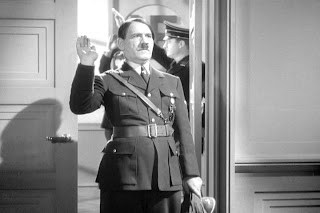


_poster.jpg)


