TSPDT placing: #541
Directed by: David Lean
Written by: Boris Pasternak (novel), Robert Bolt (screenplay)
Starring: Omar Sharif, Julie Christie, Geraldine Chaplin, Rod Steiger, Alec Guinness, Tom Courtenay, Klaus Kinski
Few filmmakers, if any, can claim to possess the extraordinary cinematic scope of David Lean. The British director began his career in the early 1940s, producing an assortment of relatively "small" drama pictures – several adapted from the plays of Noel Coward – and each exhibiting a profound understanding of mise-en-scène. However, it wasn't until 1957 that Lean discovered his true calling: Columbia Pictures gave him a CinemaScope camera. Armed with an enormous tapestry on which to paint his masterpieces, the director produced The Bridge on the River Kwai (1957), demonstrating to the cinema-going world a new standard in epic filmmaking, unsurpassed in its day and possibly even in the years since. Lawrence of Arabia (1962) – Lean's second Best Picture Oscar-winner, and probably my second favourite film of all time – cemented his reputation as the master of ambitious epic cinema, and Freddie Young's acclaimed Super Panavision 70 cinematography captured the blazing, windswept desert sands in such magnificent detail that your planned holiday to northern Africa now seems rather redundant.
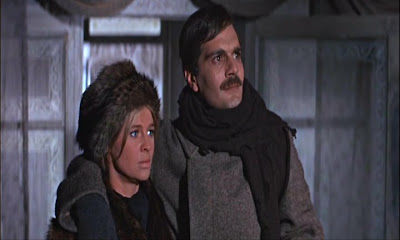 If any director was most suited to adapt "Doctor Zhivago," Boris Pasternak's mighty retelling of a difficult era in Russia's history, it was, indeed, David Lean. As was the case in his previous film, the plot itself comes second to the director's astonishing ability to capture the majesty of every instant, and to place the audience in the midst of the moment. As such, Doctor Zhivago (1965) lacks any straightforward narrative, but its strength is drawn from the incredible emotion that accompanies each turn in events: it's a story of love, loss, hope, war, family, revolution and death… basically, everything that makes life worth living. Yuri Zhivago (Omar Sharif) stumbles passively through the turmoil that is Russia during the 1910s, both before and after the onslaught of WWI, and through his submissive eyes we watch citizens acclimatise to the constantly-shifting political climates of the era. During the Revolution of 1917, and the subsequent Russian Civil War, one's very existence was forever in doubt, and the uncertainty of the times consistently casts an ominous shadow over the fate of the film's major characters.
 Filming for Doctor Zhivago, as was the case in Lawrence of Arabia, was a long and gruelling experience for all involved. As Pasternak's novel was still banned in the Soviet Union at the time of the film's production {it would not be officially published there until 1988, though several earlier samizdat editions could be found}, filming took place primarily in Spain, with several sequences also shot in Finland and Canada. This extensive location-shooting allowed Lean to accurately reproduce the splendour of the Russian wilderness: the bitter cold of the snow-swept winter landscapes, the vibrancy of the fresh and chilled summers. An entire Moscow city-block was recreated just outside Madrid, and it would take a sharp eye to discern that the icy cobbled streets of the film's opening act are not located in the Russian capital. Such are the scenes' authenticity that you shiver at the very thought of stepping outside into the falling snow, and, as Zhivago – encrusted in a numbing case of ice – trudges stiffly through the winterscape, we can almost feel our own limbs becoming numb with frostbite.
 Rarely has an epic delivered such an impressive display of acting performances. Omar Sharif, who was apparently surprised to have landed the lead character in David Lean's latest, doesn't initially strike one as being "leading man" material, but it is his passiveness in the role that proves crucial to the telling of Pasternak's story. He wanders dutifully through the changing landscape of Russia, rarely saying what he truly believes, and never displaying any genuine outbursts of emotion; he is a ghost of a person, and simply perseveres through his belief that better times are yet to come. Zhivago's primary emotional outlet is through his poetry, through which he articulates his passions and anguishes, though he only finds himself able to write when he finds himself in a comfortable living situation. His work has been condemned by the government for focusing on personal sentiments rather than the "good of the state," an ironic foreshadowing of the censorship that Pasternak himself would encounter. Nevertheless, Zhivago comes across as quite a cold and detached character, and there's a selfishness inherent in his decision not to pursue his estranged family to Paris.
 Julie Christie provides the film's primary love interest, an abused and neglected woman in whom Zhivago finds an illicit companionship. Independent, and yet very vulnerable, Lara forms the emotional core of the story, and it is through her association with the lead character that he is able to divulge his true feelings and pen his finest work. Geraldine Chaplin (for better or worse, a spitting image of her father) is also quite good as Zhivago's wife, Tonya, though her presence – perhaps intentionally – fails to evoke the same glamour and compassion as is the case with Lara. Rod Steiger, who has been greatly impressing me of late, is a slimy figure of egotism and malevolence ("...and don't delude yourself this was rape, that would flatter us both"), though his deeds in the film's final act raise a level of ambiguity that is interesting to ponder: why, indeed, did he arrive to offer Lara warning? The motives of Gen. Yevgraf Zhivago, played by the great Alec Guinness, are similarly uncertain, and his apparent detachedness - almost indifference - to the plight of his half-brother is a puzzling riddle that only a second viewing could possibly resolve.
9/10
Currently my #2 film of 1965:
1) Obchod na korze {The Shop on Main Street} (Ján Kadár, Elmar Klos)
2) Doctor Zhivago (David Lean)
3) Alphaville, une étrange aventure de Lemmy Caution {Alphaville} (Jean-Luc Godard)
Currently my #3 film from director David Lean:
1) Lawrence of Arabia (1962)
2) The Bridge on the River Kwai (1957)
3) Doctor Zhivago (1965)
4) Oliver Twist (1948)
5) Brief Encounter (1945)

 In the early period of his directing career, Lean collaborated with producer/writer Noel Coward on four occasions, and Brief Encounter is the result of their final partnership. The story was expanded from Coward's one-act place, "Still Life (1936)," and adapted by Anthony Havelock-Allan, Ronald Neame and Lean himself. In a refreshing change from most romantic pictures, Brief Encounter depicts love as a frustrating, tormenting and even violent emotion; though Laura is at first enchanted by her affection for the handsome Alec, the guilt caused by her disloyalty threatens to destroy her emotionally, and the bitter fact that her love is ultimately doomed leads her almost to suicide. Robert Krasker's cinematography is beautifully moody, often using locomotive smoke {multiple pivotal scenes take place at a train station} as an effective aesthetic device. Some have noted the film's apparent ties to the film noir genre, with Lean choosing to shoot much of the film in rain-slicked streets, dimly-lit interiors and unglamorous industrialised train stations; the film's conclusion notes the futility of love, and its tragic, detrimental effect on comfortable family relationships.
 More than anything else, Brief Encounter is an exploration of family morality. There's no doubt that Laura loves her husband, but her life with him is so tedious and unstimulating that her weekly shopping journeys into London are all that keep her functioning. Laura's romantic liaison with Alec fills her with an unbridled joy, an emotion that so overwhelms her that it is not until hours later that the ethical implications of her actions finally strike home. The devastating moment when she first finds herself lying to her husband, a minor but all-important detail, is one of the film's most powerful moments, more so when Laura later muses: "It's awfully easy to lie when you know you're trusted implicitly." With its sympathetic attitude towards marital infidelity, a film such as Brief Encounter could never have been made in Hollywood. The Production Code {a.k.a. the Hays Code} strictly prohibited the portrayal of adulterous relationships that were "explicitly treated, or justified, or presented attractively." Nevertheless, the film was David Lean's greatest critical success to date, and his film was nominated for three Academy Awards {Best Actress, Best Director, Best Writing}, in addition to tying for the Grand Prize of the Cannes Film Festival.


_poster.jpg)


