TSPDT placing: #823
Directed by: Sergei Bondarchuk
Starring: Lyudmila Savelyeva, Sergei Bondarchuk, Vyacheslav Tikhonov, Viktor Stanitsyn, Oleg Tabakov
Few people have been daring enough to even read Leo Tolstoy's epic piece of literature, "War and Peace (1865-1869)," let alone adapt it to the cinema screen. At over 1000 pages in length, the novel is notorious for its intimidating thickness, but those who have read it will usually agree that it is one of the finest achievements in the history of literature. I've never been courageous enough to attempt the story myself, but Sergei Bondarchuk's 1960s adaptation, Voyna i mir (1967) seems an equally ambitious undertaking. At over seven hours in length – usually divided into four parts – the Soviet film defines "epic" in every sense of the word, and, with a budget of $100 million {over $700 million when adjusted for inflation}, it is also the most expensive movie ever made. Watching such a lengthy film in one sitting seemed a rather daunting task, so I've instead decided to segregate my viewing into the picture's original four parts, over four consecutive nights if possible. The experience began last night with Voyna i mir I: Andrey Bolkonskiy (1965), first released in July 1965 at the Moscow Film Festival.


I'm the first person to admit that I am disproportionately impressed by epic cinema. The story may be non-existent, the performances may be merely adequate, but if there's sufficient spectacle then I'm a sucker for it. Part One of Bondarchuk's War and Peace possesses spectacle in great abundance, and, in every frame, the picture's considerable budget has been put to excellent use. Even the most brief and discreet sequences are gloriously embellished with lavish set decoration and costuming, to such an extent that the flood of colour and creativity becomes almost overwhelming. Unlike comparable masters of epic cinema, such as the wonderful David Lean, Bondarchuk apparently has little use for precise cinematographic composition, and frequently the photography is entirely hand-held, no mean feat considering the bulkiness of those 70mm cameras. In some ways, the unexpected use of this filming style is distracting and occasionally sloppy, but it also adds a unique liveliness to the proceedings – if I'm going to have to sit through a stolid costume drama, why not brighten things up a bit with a dynamic camera?


The opening hour of Andrei Bolkonsky is a watchable but occasionally tiresome introduction of the major characters, none of which are overly interesting, with the exception of Pierre Besukhov (Bondarchuk himself), whose habit for alcohol and recklessness must be stifled following the inheritance of his father's fortune. It is only during the first bloody battle that the director finally spreads his creative wings, and Bondarchuk's magnificent cinematic scope is almost awe-inspiring to behold, as thousands of soldiers courageously fall in a breathtaking conflict amid the blood and smoke of open warfare. During these sequences, the film generally avoids spending too much time on any one character, and the director is evidently most concerned with offering an "God's eye" view of events, rather than from the perspective of war's insignificant pawns. Using this method, which he also employed to great effect in the English-language picture Waterloo (1970), Bondarchuk is able to retain the "sprawling" tone of his source material, even if such spectacle comes at the expense of any intimacy that we might have had with the story's characters.
8/10
Stay tuned for Part Two.

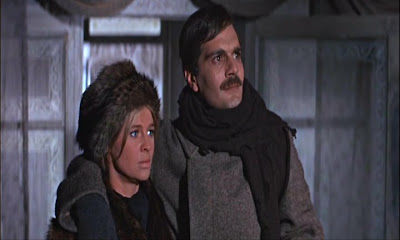 If any director was most suited to adapt "Doctor Zhivago," Boris Pasternak's mighty retelling of a difficult era in Russia's history, it was, indeed, David Lean. As was the case in his previous film, the plot itself comes second to the director's astonishing ability to capture the majesty of every instant, and to place the audience in the midst of the moment. As such, Doctor Zhivago (1965) lacks any straightforward narrative, but its strength is drawn from the incredible emotion that accompanies each turn in events: it's a story of love, loss, hope, war, family, revolution and death… basically, everything that makes life worth living. Yuri Zhivago (Omar Sharif) stumbles passively through the turmoil that is Russia during the 1910s, both before and after the onslaught of WWI, and through his submissive eyes we watch citizens acclimatise to the constantly-shifting political climates of the era. During the Revolution of 1917, and the subsequent Russian Civil War, one's very existence was forever in doubt, and the uncertainty of the times consistently casts an ominous shadow over the fate of the film's major characters.
 Filming for Doctor Zhivago, as was the case in Lawrence of Arabia, was a long and gruelling experience for all involved. As Pasternak's novel was still banned in the Soviet Union at the time of the film's production {it would not be officially published there until 1988, though several earlier samizdat editions could be found}, filming took place primarily in Spain, with several sequences also shot in Finland and Canada. This extensive location-shooting allowed Lean to accurately reproduce the splendour of the Russian wilderness: the bitter cold of the snow-swept winter landscapes, the vibrancy of the fresh and chilled summers. An entire Moscow city-block was recreated just outside Madrid, and it would take a sharp eye to discern that the icy cobbled streets of the film's opening act are not located in the Russian capital. Such are the scenes' authenticity that you shiver at the very thought of stepping outside into the falling snow, and, as Zhivago – encrusted in a numbing case of ice – trudges stiffly through the winterscape, we can almost feel our own limbs becoming numb with frostbite.
 Rarely has an epic delivered such an impressive display of acting performances. Omar Sharif, who was apparently surprised to have landed the lead character in David Lean's latest, doesn't initially strike one as being "leading man" material, but it is his passiveness in the role that proves crucial to the telling of Pasternak's story. He wanders dutifully through the changing landscape of Russia, rarely saying what he truly believes, and never displaying any genuine outbursts of emotion; he is a ghost of a person, and simply perseveres through his belief that better times are yet to come. Zhivago's primary emotional outlet is through his poetry, through which he articulates his passions and anguishes, though he only finds himself able to write when he finds himself in a comfortable living situation. His work has been condemned by the government for focusing on personal sentiments rather than the "good of the state," an ironic foreshadowing of the censorship that Pasternak himself would encounter. Nevertheless, Zhivago comes across as quite a cold and detached character, and there's a selfishness inherent in his decision not to pursue his estranged family to Paris.
 Julie Christie provides the film's primary love interest, an abused and neglected woman in whom Zhivago finds an illicit companionship. Independent, and yet very vulnerable, Lara forms the emotional core of the story, and it is through her association with the lead character that he is able to divulge his true feelings and pen his finest work. Geraldine Chaplin (for better or worse, a spitting image of her father) is also quite good as Zhivago's wife, Tonya, though her presence – perhaps intentionally – fails to evoke the same glamour and compassion as is the case with Lara. Rod Steiger, who has been greatly impressing me of late, is a slimy figure of egotism and malevolence ("...and don't delude yourself this was rape, that would flatter us both"), though his deeds in the film's final act raise a level of ambiguity that is interesting to ponder: why, indeed, did he arrive to offer Lara warning? The motives of Gen. Yevgraf Zhivago, played by the great Alec Guinness, are similarly uncertain, and his apparent detachedness - almost indifference - to the plight of his half-brother is a puzzling riddle that only a second viewing could possibly resolve.


_poster.jpg)


