TSPDT placing: #282
Directed by: Ernst Lubitsch
Written by: Melchior Lengyel (story), Charles Brackett (screenplay), Billy Wilder (screenplay), Walter Reisch (screenplay)
Starring: Greta Garbo, Melvyn Douglas, Ina Claire, Bela Lugosi, Sig Ruman, Felix Bressart, Alexander Granach
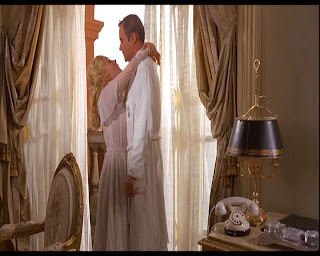
I find it a little odd that, on the cusp of WWII, Hollywood delivered a piece of anti-Communist propaganda, when clearly there were, at that time, more immediate threats to European freedom. Ninotchka (1939) was produced while Ernst Lubitsch waited for Margaret Sullavan and James Stewart to become available for The Shop Around the Corner (1940), but it was by no means merely a fill-in project: the film was Greta Garbo's first and only collaboration with Lubitsch, and the actress' penultimate role before a premature retirement. MGM's publicity campaign used the tagline "Garbo Laughs!" to advertise that this was a new type of role for the enigmatic actress, a comedy that promised to humanise her otherwise somber screen persona {this campaign deliberately referenced the tagline for Garbo's Anna Christie (1930), which had proclaimed "Garbo Talks!"}. Though the screenplay by Billy Wilder, Charles Brackett and Walter Reisch unsurprisingly has many genuine sparks of wit, the balance of romance, farce and political commentary never quite sits as comfortably as one would expect given the talents involved.
 When three Soviet diplomats (Sig Ruman, Felix Bressart and Alexander Granach) arrive in Paris to sell off some jewelry confiscated from the Grand Duchess (Ina Claire) during the Bolshevik Revolution, they find it difficult to keep their minds on their work. Far away from the cold, drab apartments of Moscow, the French capital is bustling with life, warmth and prosperity (just forget that the French upper-class are not, in fact, a reasonable yardstick for comparison with the Soviet proletariat). Playful aristocrat Léon (Melvyn Douglas), the Duchess' romantic lover, succeeds in corrupting the bumbling diplomats by flaunting the luxuries of capitalistic society. To ensure that the transaction goes through smoothly, the Soviets send down Ninotchka (Garbo), a curt, tight-lipped Bolshevik with a militant hatred of Capitalism and everything it stands for. Against all odds, the debonair playboy Léon and the belligerent Ninotchka fall for one another, an attraction that ultimately proves more significant than one's national allegiance.
 Unfortunately, once love softens the formerly stone-faced Ninotchka, the film shifts from being a lighthearted political farce {not unlike To Be or Not to Be (1942) or Wilder's One, Two, Three (1961)} to a weepy romance. Lubitsch followed Ninotchka with The Shop Around the Corner. What worked so well in the latter film, I thought, was that Lubitsch's heart was not necessarily with the star-crossed lovers – James Stewart and Margaret Sullavan – but with Frank Morgan's shop owner, and his familial relationship with its employees. The three reluctant Soviet diplomats in Ninotchka are utterly charming supporting characters, but too often they are shunned in favour of the central romance, which seems to tread water once, as advertised, Garbo breaks character and enjoys a hearty chuckle. Nevertheless, Melvyn Douglas is magnificently debonair, bringing something distinctly likable to the role of a lazy playboy aristocrat. During her opening act, you can almost see a smile forming beneath Garbo's icy exterior, and she plays the role with just the right amount of breeziness.
6.5/10
Currently my #11 film of 1939:
3) Only Angels Have Wings (Howard Hawks)
4) The Wizard Of Oz (Victor Fleming, Mervyn LeRoy, Richard Thorpe, King Vidor)
5) Gone with the Wind (Victor Fleming, George Cukor, Sam Wood)
6) The Story of Vernon and Irene Castle (H.C. Potter)
7) The Hunchback of Notre Dame (William Dieterle)
8) La règle du jeu {The Rules of the Game} (Jean Renoir)
9) Dark Victory (Edmund Goulding)
10) Another Thin Man (W.S. Van Dyke)
11) Ninotchka (Ernst Lubitsch)
12) Drums Along the Mohawk (John Ford)

 Jack Lemmon plays Wendell Armbruster, Jr, a wealthy American businessman who boards the first plane to Italy following the news of his father's death. Wendell Armbruster, Sr was killed in an automobile accident while on his annual pilgrimage to the Grand Hotel Excelsior, where he goes, he says, to rejuvenate in their famous Italian mud baths. It doesn't take long, however, for Wendell to discover that his much-respected father had not died alone, and that his secret English mistress of ten years had also perished when their vehicle ploughed off a winding road and into a vineyard. Pamela Piggott (Juliet Mills), the mistress' open-minded daughter, has also arrived in the country to claim her mother's body, and Wendell treats her poorly, his steadfast morals refusing to acknowledge their parents' liaison for the great love that it was. As the two corpses become embroiled in endless lengths of red tape – including the need to acquire two zinc-lined coffins, and no shortage of obscure contracts to be signed – Wendell and Pamela begin to understand their close connection, and form a touching relationship of their own.
 Though the two leads both deliver sterling comedic performances, Clive Revill is undoubtedly the film's highlight as Carlo Carlucci, the world's most accommodating hotel manager. Blessed with political connections of all kinds, and an inability to sleep until the hotel's off-season, Carlo darts endlessly across town to tie up all the loose ends, apparently expecting nothing in return – he's probably Wilder's all-time nicest comedic creation. The narrative style is similar to that of Arthur Hiller's The Out of Towners (1970), in that the story is comprised of many consistently-mounting setbacks, though the overall effect is far less frustrating for the audience and spares sufficient time to allow some important character development. There is also a rather unnecessary subplot involving a deported American immigrant and his disturbingly-masculine girlfriend, and the film, however nice its intentions, does run about half an hour overtime. Nevertheless, Avanti! is a mature romantic comedy with memorable performances and a very enjoyable story; I wouldn't be surprised if it warms to me greatly with repeat viewings.
 Currently my #15 film from director Billy Wilder:
 What others have said:

 James Cagney plays C.R. "Mac" MacNamara, a proud veteran of the Coca-Cola Company, who has dragged his family around Europe for the past fifteen years in futile pursuit of the European managerial position. Now located in West Berlin, his goal is seemingly within reach, despite the elevating friction between the Americans and the Communists of the East. Just on the verge of a groundbreaking deal to distribute Coca-Cola across the Iron Curtain, Mac is unexpectedly asked by his boss (Howard St. John) to babysit his hot-blooded seventeen-year-old daughter, Scarlett (Pamela Tiffin), during her stay in Berlin. When Scarlett suddenly announces her marriage to a fierce Communist radical, Otto Ludwig Piffl (Horst Buchholz), Mac realises that he has just hours to transform this unapologetic Yankee-hater into the perfect son-in-law, otherwise his career is as good as doomed. Racing frantically around his office, barking orders with incredible ferocity, Cagney is absolute dynamite in the leading role, the film's hectic conversational pace often reminiscent of a Howard Hawks film, particularly His Girl Friday (1940) {which Wilder notably remade in The Front Page (1974)}.
 Though some of the jokes occasionally miss their mark, the screenplay by Wilder and I.A.L. Diamond {adapted from the one-act play by Ferenc Molnar} is brisk, intelligent and regularly very funny. The supporting characters each bring a streak of vibrancy to the darkly-themed satire, and, though Cagney always dominates his scenes, each performer complements him well. Schlemmer (Hanns Lothar), an ex-SS member who denies everything, habitually clinks his heels together at every order, despite being asked on multiple occasions to cut it out; Phyllis MacNamara (Arlene Francis) resents her husband's neglect of his family, and verbally articulates her frustration by referring to him as "Mein Fuhrer"; Fräulein Ingeborg (Liselotte Pulver) is Mac's sexy, ambitious secretary, and Wilder certainly knows how to make good use of her. Filled with amusing characters and situations, and more film references than I was able to count, Billy Wilder's One, Two, Three is surefire Cold War entertainment, and fans of James Cagney will relish the opportunity to witness Rocky Sullivan playing the comedian.
 The Apartment (1960) was written by Billy Wilder and regular-collaborator I.A.L. Diamond, and is every bit as intelligent, witty and classy as the likes of Sunset Blvd. (1950) and Double Indemnity (1944). Though certainly not as laugh-out-loud hilarious as Some Like It Hot, the film dispenses comedy, romance and drama in such perfectly-portioned satchels that only a master could have helmed the production. Cinematographer Joseph LaShelle shot the film in crisp black-and-white, subduing the otherwise festive atmosphere of the Christmas-time setting and creating an air of bittersweet melancholy, the sort of sensation one feels when left alone with a joyful celebration – its sounds muffled by the adjoining walls – taking place in the next room. The Apartment is also a meditation on loneliness. Though Baxter has developed an unearned reputation as something of a "party animal" {allowing for some amusing confrontations with his neighbour, Dr. Dreyfuss (Jack Kruschen)}, he is very much a solitary figure, disheartened by the general slackening of society's moral standards and left wondering why nice guys always finish last.
 Of course, I couldn't review The Apartment without also mentioning the performances of Shirley MacLaine and Fred MacMurray, who help form the film's pivotal romantic triangle. MacLaine's Fran Kubelik, one of the building's elevator operators, is bright and independent in most respects, but has found herself romantically exploited by the insurance firm's director, Jeff D. Sheldrake (MacMurray), who has promised her a steady future but refuses to divorce his current wife. MacLaine brings a beautifully-balanced combination of intelligence and vulnerability to the role, at first appearing to be a carefree, upright young lady before slowly revealing vital flaws in her character. MacMurray, who I'd previously enjoyed as Walter Neff in Wilder's definitive film-noir, brings just the right amount of smug condescension to his interactions with Baxter, and his character's attempts at earnestness are immediately transparent as acts of unashamed manipulation. At the 1961 Academy Awards, voters were obviously impressed with the film's ability to tell a great story without the usual syrupy hijinks, and The Apartment took away a deserved five Oscars, including Best Writing, Best Director and Best Picture – the final black-and-white film to do so before Steven Spielberg's Holocaust epic, Schindler's List (1993).


