TSPDT placing: #128
Directed by: Michael Powell, Emeric Pressburger
Written by: Hans Christian Andersen (fairy-tale), Emeric Pressburger (original screenplay, written by), Michael Powell (written by), Keith Winter (additional dialogue)
Starring: Marius Goring, Anton Walbrook, Moira Shearer, Austin Trevor, Albert Bassermann, Ludmilla Tchérina
WARNING: Plot and/or ending details may follow!!! [Paragraph 2 only]
Aside from a few compulsory school-related occasions upon which I look back with the utmost antipathy, I've never danced in my life. I've never wanted to, and I plan to hold firm at least until the day of my wedding. As late as last year, I regarded ballet as among the least interesting forms of dance, my assertion based not on experience, but mere conjecture. Then I saw Norman McLaren's extraordinary short film Pas de deux (1968), in which an optical printer is used to demonstrate how the dancers' movements transcend space and time, the majesty of human motion revealed in every gentle, graceful spin. Suddenly, inexplicably, I saw beauty where I'd never seen it before. I consider The Red Shoes (1948) the affirmation of this revelation. The child of writing/directing team Michael Powell and Emeric Pressburger, under the banner of The Archers, the film showcases the pair's talent for imbuing their work with lush colours, warmth and personality, displaying a faculty for capturing atmosphere that is unmatched then or since.
 The Red Shoes revolves around the production of a stage adaptation of Hans Christian Andersen's eponymous fairy-tale, in which a ballet dancer receives a pair of cursed red shoes that keep her dancing until the day she dies. However, rather than being a simple story of success in show- business, the behind-the-scenes events are themselves a loose variation on Andersen's fairy-tale. When asked what she wants from life, young British ballerina Victoria Page (Moira Shearer) replies, "I want to dance." Just as Mephisto offered Faust everything he wanted at the cost of everything he held dear, Boris Lermontov (Anton Walbrook, of The Life and Death of Colonel Blimp (1943)) offers Victoria immortality in the art of ballet, but at the expense of life, love and happiness. Finally, torn between her two great loves – to her husband Julian (Marius Goring), and to ballet – she chooses to abandon both, throwing herself in front of a train as though compelled to do so by the red dancing shoes that had so overwhelmingly commanded her life.
 As in most Powell/Pressburger collaborations, it's not adequate to merely praise the co-directors. Hein Heckroth's costumes, Arthur Lawson's art direction, Jack Cardiff's lush cinematography, Brian Easdale's musical score; all are utterly masterful, the fruits of a alliance in which every crew member understood perfectly what was required of them. The film's incredible centrepiece is a twenty- minute balletic interlude in which the audience is shown the stage production itself, perhaps the most breathtaking and purely cinematic musical sequence I've ever seen. As Victoria Page is swept up in the fantasy of her role, she is inundated by surreal visions of Faustian tragedy and horror that deliberately recall F.W. Murnau's 1926 film. In Hollywood, The Red Shoes proved hugely influential, noticeably inspiring the likes of Stanley Donen and Vincente Minnelli: An American in Paris (1951) featured a similar, if not so comfortably integrated, ballet interlude, and The Band Wagon (1953) feels like a sunny feature-length rebuttal to the tragedy inherent in The Archers' film.
8/10
Currently my #5 film of 1948:
1) The Treasure of the Sierra Madre (John Huston)
2) Ladri di biciclette {The Bicycle Thief} (Vittorio De Sicae)
3) Rope (Alfred Hitchcock)
4) Oliver Twist (David Lean)
5) The Red Shoes (Michael Powell, Emeric Pressburger)
6) Macbeth (Orson Welles)
7) Key Largo (John Huston)
8) Letter from an Unknown Woman (Max Ophüls)
9) Secret Beyond the Door… (Fritz Lang)
10) Musik i mörker {Music in Darkness} (Ingmar Bergman)
2) Ladri di biciclette {The Bicycle Thief} (Vittorio De Sicae)
3) Rope (Alfred Hitchcock)
4) Oliver Twist (David Lean)
5) The Red Shoes (Michael Powell, Emeric Pressburger)
6) Macbeth (Orson Welles)
7) Key Largo (John Huston)
8) Letter from an Unknown Woman (Max Ophüls)
9) Secret Beyond the Door… (Fritz Lang)
10) Musik i mörker {Music in Darkness} (Ingmar Bergman)

 Not surprisingly, given the director's nationality, Letter from an Unknown Woman (1948) has the feel of a European film. It's a bit difficult to put my finger on exactly why this is, but the Viennese setting probably contributed. Additionally, American romances – both of that time, and today – usually seem so anxious to please, doling out hope with every new meeting, and typically ending with the heroine carried off into the sunset in her eternal lover's arms. It's for its acknowledgement of the hopelessness of love that Ophüls' film, and others such as Lean's British-made Brief Encounter (1945), are regarded above most romantic pictures; after all, is there any love more poignant and memorable than unrequited love? Joan Fontaine, a favourite actress of mine, is as delicate as a flower, a quality that Hitchcock notably exploited twice in both Rebecca (1940) and Suspicion (1941). Her love for the dashing French pianist Stefan Brand (Louis Jourdan) is so incredibly passive that you already know that she's going to lose him.
 Throughout the film, Lisa Berndle watches her lover from afar; she listens to his music through the physical barrier of a door; she quickly comes to know him, but only later comes to meet him. Fontaine's character is simply too weak to succeed in love, and only in her dying moments does she realise that her strength of will was required to bridge the gap between herself and the womanising, forgetful Stefan, who probably loved Lisa but never realised it. Though Ophüls' narrative framing device suggests the intervention of fate – that faceless, indifferent force to which most failed cinematic romances are attributed – into the couple's doomed romance, the blame instead falls to the two lovers. Their personal failings not only denied them love, but ultimately granted them death. That we are alerted to these inevitable eventualities in advance (both through the framing device, and a coldly-brutal sequence that indifferently alerts us, but not Lisa, to a typhis outbreak) makes it all the more difficult to bear.
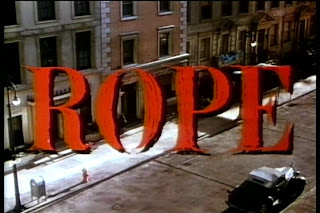 Alfred Hitchcock, despite his commercial popularity, was perhaps one of cinema's most audacious technical innovators. Even very early in his career – Blackmail (1929) was the first British film to make the cross-over into "talkies" – the Master of Suspense was forever searching for distinctive new means of telling a story and furthering his craft. Hitchcock was particularly interested in film-making that unfolded almost exclusively in a single restricted location, perhaps because of its likeness to a traditional stage play, or, more tellingly, because it allowed him to place the audience "in the room" with his nefarious characters. The director's first such endeavour was the radical Lifeboat (1944), which took place entirely on a small boat in the middle of the Atlantic, and similar "one-room" thrillers include Dial M for Murder (1954) and

 What others have said:


_poster.jpg)


